Thursday, September 07, 2006

The Rantings of a Church Planter (It's Not Me)

I was surfing the net and stumbled upon a blog by a church planter. I agree with most his rants. His talk about being a church planter vaguely resembles mine:

There is nothing easy about a church plant. We set up and tear down every week. Every Saturday we wonder if people are going to show up. We are the pastor, IT guy, graphic designer, etc. Pastoring an established church isn't easy either but it would be a lot easier sometimes to find a church that didnt have to deal with the stuff we deal with.


I totally agree. I don't have a church administrator, so I'm the one who designed and maintained the webpage, designed the bulletins and flyers, write edit and mail the newsletter and when I have the chance, plan worship services and write a sermon to preach. Did I mention I'm also the chief fundraiser? When you are a new church pastor, you do it all. It is not easy; in fact, it's damn tiring.


At times, I've thought seriously about just giving this all up and find a nice small church to pastor and get a check from it (yeah, I don't get paid for all this. Well, that's not totally true- the middle ajudicatory in my denomination has given us a small grant that went to stipends, but without that, I'm pretty much not getting money). I mean, I get tired of trying to do my 40 hour week job and then try to plan a church service. I get tired of asking for financial support from people. I get tired of wondering if the church will survive with lack of funds.

Seems like Greg's been there too:

Every Monday I am so worn out I can barely get out of bed. Every Monday I tell my wife that I just want to find a small mountain church where all I have to do is preach three times a week and visit the members and get a paycheck. Every Monday I just want to find a place where they don't want the pastor to be the leader, have a vision or reach lost people. Sounds a lot easier to me. Then DeAnna reminds me that yes I could do that but that I would die a slow death. She is right. She always is.


The thing is, I have a passion for new church. This is what I want to do. Being the pastor of a new church has been hard, but it has also stretched me in ways that I never would have in an established church. While I don't agree theologically with Greg, I can understand his passion:

The fact is we don't do church the way we do to be cool. I am sure some do but they don't last very long. We do it because we think people are dying and going to hell. Because of that conviction, we feel as if we must do WHATEVER it takes to reach these people. I could care less about doing church the way we do it. If there was another way to reach lost people, we would do it. I admit I take it personally when people say these things because I know what fuels me and the church planters I know is very simply that fact that we have a burning desire to reach those people that would never darken the door of an established church. That is it. I don't care about anything else. We don't do it for the money, because it easier, because it is the way to build a church, we simply do it because people need to hear the message of Jesus Christ.


Now, I'm not sitting here worrying that someone is hellbound. I used to, but these days, I believe in a more gracious God. However, he is correct that there are a lot of people who come to Community of Grace that would never darken the door of an established church. Many of them have felt unwelcomed because of their sexual orientation, and now they have the certainly that God loves them just the way they are.

I wish that people were more passionate about new churches and about finding ways to support them. CoG is doing some great things reaching out and showing that God loves them in word and deed.

Being a new church pastor is hard, but damn well worth it.

Thursday, August 24, 2006

Help Community of Grace Hire an Accompanist!

headshot_dan_adolphsonMost of you know this is Dan Adolphson, the Co-Pastor and Music Director (Cantor) for Community of Grace Christian Church. Right now Dan is pulling what little hair he has (and we do mean what little hair). You see, Community of Grace is looking to hire an accompanist to assist Dan with the music during our services. And with the help of my boyfriend Daniel, Dan found someone that would be a great asset to our team.

There is just one teensie problem:

WE HAVE NO MONEY.

So, this is where you all come in. For Community of Grace to hire this person, we need about $1000 to $1500. Some of this we will get through a grant, but we need to come up with the rest.

I'm asking you to consider giving what you can to help Dan out. Whatever you can give-even if it's $5 will go a long way to helping Dan hire this wonderful musician.

If you want to donate, you can go to the donation button that the bottom of this post. Please consider helping Community of Grace out. Don't let Dan have to tear those 10 remaining strands from his head. Thanks.


*Dan's going to kill me, but you have to have a sense of humor in raising money. You just gotta.

Friday, August 18, 2006

Money and the Church

There are times I want to believe that a church can be started and operated with little to no money. I want to believe the pastors and church musicans will work out of the goodness of their hearts with no concern for payment.

But the fact is, if you want to have an effective church, you do need some money.

Every so often, something happens that jolts me out of my happy thinking. I hit that on Wednesday evening. Community of Grace wants to have an accompanist that will work with our Cantor, Dan. I asked him where we were in the process, and he said that it was pretty much halted. The musicians want to be paid, and I can't blame them. You put in a lot of time and hard work, and you want to get some reumneration for that. Not to mention, church people have financial needs just like anyone else.

My boyfriend, who is a music director, has offered to help us in the meantime and I am thankful. He is a whiz at the piano. The only concern I have is he has a job in North Dakota and then drives five hours to see me. After a long day, I feel bad asking him to play again.

It's also hard to get accross to people the need for financial support. Our Region doesn't have a whole lot of financial resources, so we have to rely on the kindness of strangers. In this part of the country,it is hard to move people to support a new church like hours. You do try to tell people it costs to keep a website going or to get hymnals and the like and it seems to fall on deaf ears.

I also battle with the thoughts that all we have to do is meeting in living room and maybe listen to taped music or something. I remember attending an Anglican church a few years back that didn't have a pastor at the time. It was a very small congregation that was basically a house church. They never started on time and sometimes had a "community sermon" where people would talk about the scripture that day. At first, it seemed exciting. But after a while, it became boring and felt more like unattractive chaos. There is nothing wrong with being a house church; it's just that this isn't what I want. I would like some order and for church to feel like church. I did the meeting in living rooms thing in college and have no desire to do it again.

Then there is the fact that I or the cantor are getting paid. Neither of us are working in the church for the money. I can't speak for Dan, but I love what I do and would do it for free (as I have virtually done for two years). But the reality, is that I have bills to pay. Pastors have house notes, car notes and student loans just like everyone else. So, why do I feel like a leech when I desire to want to make even a small salary for all the work I do? Would I feel this way if I were a lawyer?

Blech. I wish money wasn't a concern.

Tuesday, August 15, 2006

Where is the Church?

A few weeks ago, I had the opportunity to do my first funeral service.

It wasn't one I wanted to do. Someone well known in a subsector of the Twin Cities gay community committed suicide over Pride Weekend last June and his death sent shockwaves throughout the GLBT community and the wider community as well. The service was pretty emotional, to say the least. I didn't know this guy well, but I did know him and will miss him.

This person's death made me start wondering a lot about church and about our role in the wider world. In the past year, I've been busy trying to develop new and flashy services to get people into the church. The results at Community of Grace haven't been very positive. All of this caused a lot of frustration on my part. Why wouldn't someone want to come to our church? While I was kevetching about getting more butts into pews; there was a guy my age in deep emotional pain.

I'm not under any illusions that I or anyone else at CoG could have prevented him from taking his life. But I do wonder what would have happened had someone been there for him to talk to if he wanted to.

For the last year, I operated under the assumption that I needed to get people to church. I was wrong. Remember the Great Commission? Jesus tells us to go into the world and be his witness, NOT to bring them to church. As Christians, we are called to be in the community, to be witnesses of Christ to a hurting world.

And no, I'm not talking about sharing Bible tracks or telling people to "come to Jesus." I'm talking about entering our daily lives and being who were are: followers of Christ. It means being honest that we are Christians and being there for others. Maybe that means feeding a hungry person. Maybe it means being a listening ear to someone that just wants to talk. When we show love and concern for others we are being Christ's witnesses.

This summer, Communuity of Grace took a summer sabbatical to prepare for fall. I can tell you that the direction of church will change. Our worship services have to be less about packing them in and more about empowering people to go into their daily life at work and at play and "being Church" to others. It will be more about a church on a journey, instead of a destination.

It's sad that it took a tragedy for me to wake the hell up.

Where is the Church? Hopefully wherever there are people.

Monday, July 10, 2006

Explorers Wanted.

I sent this email out to spread the word about Community of Grace. If you know of anyone who lives in the Twin Cities area and is interested, please send them my way. Thanks.

As he walked by the Sea of Galilee, he saw two brothers, Simon, who is called Peter, and Andrew his brother, casting a net into the lake—for they were fishermen. And he said to them, 'Follow me, and I will make you fish for people.' Immediately they left their nets and followed him. As he went from there, he saw two other brothers, James son of Zebedee and his brother John, in the boat with their father Zebedee, mending their nets, and he called them. Immediately they left the boat and their father, and followed him.
-Matthew 4:18-22


Dear Friends,

Community of Grace is looking for a few good people.

As many of you know, about two years ago, I helped start a new church called Community of Grace. The community has had its ups and downs over the last two years, but we have made a difference in the lives of people here in the Twin Cities.

As we near our second anniversary, I'm sending out an email to seek people who are willing to join this ragtag bunch. Since we started in 2004, we have been a small group that meets for worship. This small group has done some wonderful things, such as raise $1000 for the Minnesota AIDS Project. But for Community of Grace to thrive, we need a slightly larger group that can work together as a team to do God's work in the world.

This is where you come in.

We are looking for 15-25 people who would be willing to commit to being part of this new church. We are looking for solid people who are ready for an adventure, believe in the vision of Community of Grace and are ready to contribute their piece to a shared vision. I know that many of you know people like this or at least, know people who know people like this. Talk to your friends. Share this email and the attachment with them. Go to our website to learn a little more about us and pass that on to some "spiritual thrill-seeker" that you happen to know.

Who knows...maybe it's you that is looking a for an adventure!


If you find someone that is crazy enough to join us in our journey, feel free to have them contact me. I can be reached at dennis@communityofgracemn.org.

When Jesus called the disciples, he was calling them to leave their ordinary lives and join an adventure, and what an adventure it was. God still calls each one of us today, to live lives for others.

Thanks and I look forward to receiving messages from fellow Explorers.

Monday, June 12, 2006

Sermon-Trinity Sunday, June 11, 2006

“Three is a Magic Number”
Isaiah 6:1-8, John 3:1-17, Romans 8:12-17
June 11, 2006 (Trinity Sunday)
Community of Grace Christian Church
New Brighton, MN


Why?

That one little word, sends fear into the hearts of many an adult, when a child asks it. I remember when I was about seven or so and I was playing with my friend Quentin. We had to come in for a moment, while his mother gave him some medicine for his asthma. I was curious about this so I asked why he had to take the medicine. I had asthma too, so I wanted to know. She answered my question and then I asked another one which I can't remember. After a while, Quentin and I went back to playing around and I forgot all about my questions.

A few days later, my mother told me about the incident. Unbeknownst to me, Quentin's mother had contacted my mother about what I did. My mother, told me that it was wrong to ask questions. Of course I responded by saying, why? I can't remember Mom's response, but it was basically a kind of “because-I-said-so” kind of answer.

Most parents are exasperated by such questions by kids. I sometimes wonder why questions upset adults. Having now been on the other side trying to answer the questions of others, including grown adults, I tend to think we don't want to come up short. We are afraid that someone might find out that we don't know everything, so it's best to not allow questions.

During my college years, I was involved with a college church group. What was interesting was that we learned to present the Gospel in a clear way that never really allowed for questions. I specifically remember another member of the group talking about their experience sharing the gospel with a friend who asked question after question after question. I remember the campus pastor saying that these questions were basically excuses to not accepting the gospel. Interesting, I thought.

I think it's a sad development that people who are religious tend to be so resistant to questions. It doesn't matter what end of the spectrum, be they liberal or conservative, there are people who seem to have all the answers and seem confident in themselves. Their faith is less a mystery to enter into than it is something that shores up what they already believe.

Today, this first Sunday after Pentecost, is considered Trinity Sunday. It is the Sunday of the year that we devote ourselves to a teaching of the church that dates back from it's beginnings: the Triune God-God the Father, God the Son and God the Holy Spirit.

Now if there is a day when going to church brings up questions, it has to be this day. Every since I was little, I could not figure the Trinity out. Three persons, one God? What does that mean? And you know what? Four years of seminary didn't even come close to answering the question. My professors seemed to think this was just something to be accepted and lived instead of solved. Well, thanks a lot. I'm putting myself in hock for this?

I think I can understand how Nicodemus felt during and after his visit with Jesus. Being born again? What the heck does that mean? Born of water and Spirit? I would feel just a silly as Nicodemus: all this education and I don't understand what Jesus is talking about.

I have to say that I like dear old Nick. This religious leader sometimes gets ridiculed because of his background, but Nicodemus is a true seeker. He was questions and he wants answers. When he hears Jesus talk about being born again, he confuses the Greek word anothen. The word is a synonymn, and it can mean born from above or born again. When our friend, Nick heard it, he started thinking of a grown man trying to get back into his mother's womb.

But that wasn't what Jesus was talking about. Nor was it as some would believe about a specific event when we were saved. What Jesus is talking about is to see things with different eyes: to enter into the life of the Spirit.

When Jesus talks about the flesh, he isn't saying that the flesh is bad, but you can't understand the things of the Spirit only with the flesh. Let me put this in English: faith can't be understood with only the mind. It isn't a rational exercise. It is only when we enter the life of the Spirit that we are able to understand and the Spirit is any but logical. Jesus likens it to the wind, that blows where it blows. The Spirit carries you to places you wouldn't expect.

It's a lot like playing in the ocean. Back in the mid 90s, I lived in Washington, DC and sometimes would take trips to the Maryland or Delaware shore. I would have fun swimming in the Atlantic. I remember one time just playing around and when I realized it, I was far away from the beach. The ocean currents had slowly moved me father and farther away from the shore.

That's what the Spirit is like. It moves us like the wind, or a strong current. If you want an example of what it means to live in the Spirit, simply look at Jesus' life. He was led to different places and events not of his choosing.

Nicodemus wanted an answer to his questions. Jesus gave them, but they were answers that had to be lived, not simply heard. Jesus wasn't giving an answer that would satisfy the mind; he was offering Nicodemus the chance to enter another reality, a new way of thinking and seeing.

This leads us back to all my questions about the Trinity. Now the word “trinity” doesn't occur in the Bible. But I do believe that the concept of the Trinity is there, even if there isn't a word that denotes it. In John 3 Jesus talks about God sending God's Son to save the world and we hear about the Spirit as water and as wind. Even after all this time I still can't figure out the Trinity but I can understand it. I don't have a perfectly logical answer, but I have one that I can live into.

The Trinity helps us to explain who God is. In our verses today, we see God as one that purifies us for mission, as God did to Isaiah. God is the One that loves creation so much that he wants to redeem us and so he came in the form of a human to live with us. And the Spirit is there to bring us more and more into the likeness of God, sanctifying us and helping us to see what God wants of us.

I can't understand the whole 1+1+1=1 equation, but I can understand that the Trinity shows us a God that passionately loves us. That's an answer I can live with, it doesn't explain a thing and yet it explains everything.

Is God limited to three ways of understanding? Of course not. Does it give an adaquate understanding of the totality of God? No, because God is bigger than we can imagine. The Bible is filled with mulitudes of images that show God. But the Trinity reminds us that this God we encounter loves us passionately, from the creation or the world until today. God is not a distant being, not a clockmaker God who made the world and then walked away, but a God that deeply loved us and never stopped loving us.

Earlier this year, Jim our moderator and I started a class going over the basics of the Bible. I have to hand it to Jim, he had a lot of questions. A lot. Many. I look back at those studies and I can remember being so nervous. Was I giving the best answers? I surely hope I was. But I think what I learned from the experience was not to give the perfect answer. From what I could tell, Jim, you didn't need a perfect answer. I could see the joy in your eyes from just being illuminated. I think that is what it means to live in the Spirit. You hear God in a song, or in a sermon, or in the smile on a friend and you want more.

Can we be born again? In the last few months, I've been rather down about church. I was seeing Community of Grace through human eyes: worried about numbers and wanting to be a “proper church.” Last Sunday, I saw things differently. We were still small in number, but I felt that things were different. I was seeing things through different eyes: I was born again: seeing things through the Spirit's eyes.

The answer is yes: we can be born again and again and again. Let us see life through the eyes of the one we call the Comforter and the Advocate. May it take us places we never expected. And may we never be the same. Thanks be to God. Amen.

Tuesday, May 30, 2006

On the Worship Wars (Warning: Rant Ahead)

Community of Grace Cantor, Dan Adolphson.


If there is something that can get my dander up, it's the ongoing wars between those who like a more traditional style of worship and those who like a more contemporary (read: praise music) style. I grew up as an evangelical whose worship included a lot of praise music. As I grew older, I started to appreciate and savor more traditional styles, especially the high church worship. When I head back to my hometown of Flint, Michigan to visit my parents, you will see this kid who was raised in low churches, going to the St. Paul's Episcopal Church in downtown Flint to get some good ole Anglican worship.

I enjoy and prefer more traditional worship, but I've learned to respect the more contemporary styles as well.

So, what bugs me is how some people tend to view the other style with disdain and even in some instances question people's faith.

What got me ticked off was a website I was viewing. The website belonged to a new church start belonging to a major mainline Protestant denomination. I was reading one of those "get to know the pastor" page and at the end of his bio, he made some off the cuff remark about liking high church and not liking praise music. To be more exact, he said called praise music pseudo-ethusiastic and then said it was intolerable.

Hmm. That's a good way to bring people to your church.

Frankly, I don't see understand that. You don't have to like praise music. I don't like all of it. But the fact is, there are many people who do like it and it allows them to worship God. It might have been that a certain one of those "intolerable" songs may have got someone off drugs, or helped them see God in a new way, I don't know. What I do know is that you or I can say that's not our preference, but we sure as hell should never say it's intolerable.

I don't think God gives a rat's ass how we worship. I don't think God cares if we have a service complete with an organ bigger than Jesus, or with a praise band. What matters to God is that we come together to remember the One who has given us life, life abundant, and then go out and bring God's message of love and shalom to a world that sorely needs it.

If God doesn't care, then why the hell should we? If someone wants to sing "Great is the Lord", then let it rip. If they want all the smells and bells, then more power to ya. But don't get into this silly pissing match of which worship is more holy. God doesn't give a damn.

Listen, what matters is that the worship we do mirrors the lives we try to lead. In the Bible God gets angry at those who worship and yet treat the poor with disdain. I didn't see anywhere we God is angry because a church chose to sing "Open My Eyes, Lord."

At times like these, I am thankful for Community of Grace's cantor, Dan Adolphson. He also comes from an evangelical background, but is trying to get people to accept blended worship. Dan is musically trained and can go from Michael W. Smith to Bach like no one's business. He did a wonderful rendition of Sandi Patty's "Was it Morning Like This" on Easter that was beautiful. It sure as hell wasn't intolerable.

So, to those who get in a snit about contemporary or traditional worship, I have to say this: please get a life. I think God has more important things to deal with and so should you.

Sunday, May 21, 2006

Behold, the Microchurch! (Or Nanochurch)

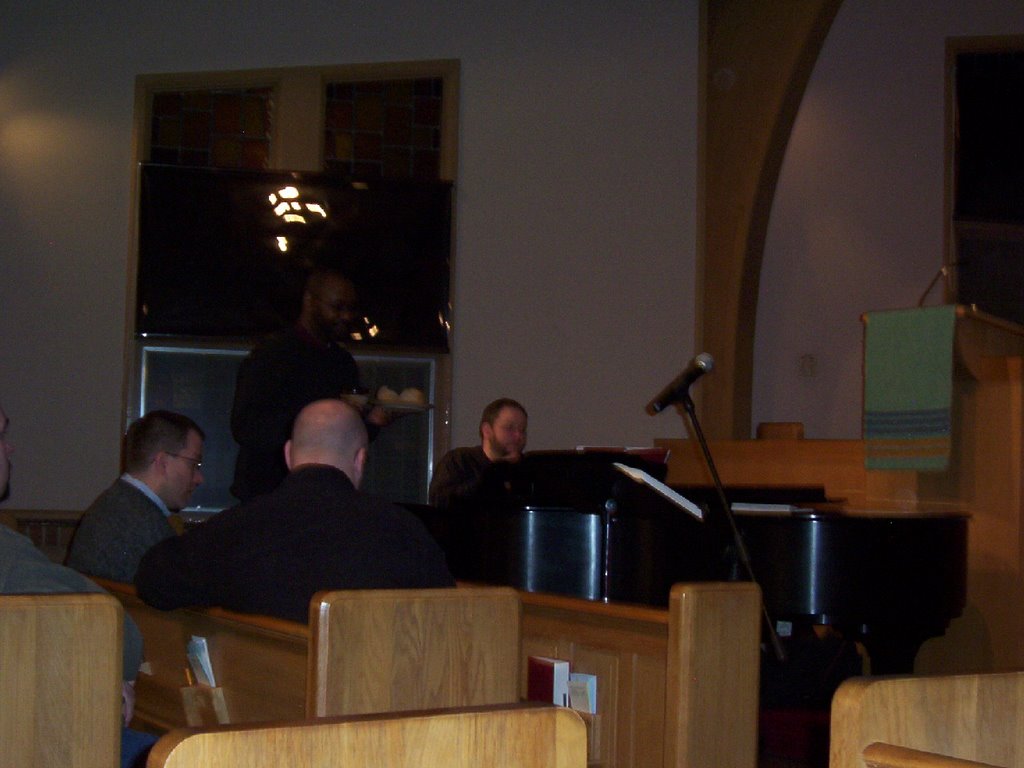
Members at a recent service.


Community of Grace is tiny. We have eight members. Count 'em. Eight. We have people who attend on occasion, but it is these eight that are the regulars. For a while, that bothered the pastors, because we wanted the church to be this "growing" church. Some of us might have even thought we would be a mainline Protestant version of a mega-church.

But that hasn't happened, and it has led the staff to be depressed.

On May 11, the church had a meeting just to find out where we are at. Over and over again, the message seemed to be that maybe it's okay to be a small church for now. Jim, our moderator, chided the staff (me included) for being so caught up in the numbers game. In his eyes, we were doing fine.

I have to say, hearing all this took a ton off my shoulders. For a while, I felt we had to be this growing church, like all the stories I hear about other new church starts and have hundreds in worship with a paid staff and anything short of that would be a failure. But Jim was reminding us of that old "where two or three are gathered" line. God's Spirit is still with us even when we are small in number.

I think I'm more than fine with CoG being a small church, even a nanochurch. Maybe in this time of bigness that has filtered into church life, there needs to be space for small communities of faith.

At that May 11 meeting, some commented that people who have visited in the past didn't like the smallness. They wanted to be anonymous; to come and worship without being known. Frankly, I don't understand that kind of worship. I mean, is that even church? Church to me is about community, it's about a group of people that are there for you when times our rough and celebrate when things go well.

Community of Grace will never reach those kind of people. But I do believe we can be a place for people who want to be part of an intimate community that worship, prays, laughs and cries together.

I came accross this interesting article about Micro Churches and realized that this is what Community of Grace is all about.

Small can be good.

Tuesday, May 16, 2006

Sunday Sermon-Fifth Sunday of Easter: May 14, 2006

The title of this sermon lends it's name from recent song of the same name from the Irish-rock group, U2. They also happen to be one of my favorite bands.

“Sometimes You Can't Make It On Your Own”
John 15:1-8; Acts 8:26-40; I John 4:7-21
May14, 2006
Community of Grace Christian Church
New Brighton, Minnesota


Ten years. I've lived in Minnesota for an entire decade. It's hard to believe that 10 years have gone by so fast. In those ten years, I've dealt with -32 below temps (and that was the air temp, NOT the windchill), going to seminary, graduating seminary, getting ordained, getting new jobs, losing jobs, helping to gather a church, falling in love, falling out of love and falling in love all over again.

There has been a lot of good and bad that has happened in the past 10 years, but there has also been some very bad times. You see, in November of 1996, I got pretty ill; bad enough that ended up in the hospital for two weeks.

It started as the flu. I was working at a local coffee chain and just felt terrible. I took a few days off and thought I felt better. I worked a few days and then got ill again. This time it was worse. I could not keep anything down and spent most of the day in bed. At some point, I started having trouble breathing. I later found out that it pnuemonia. When my Mother found out, she wanted to know if she and my Father should drive from Michigan to Minnesota. At first, I said no, but in the middle of the night when I could hardly breathe and in the midst of pain, I told my parents I needed them.

Within a few days, I was in the hospital. I found out I had a massive infection, with fluid surrounding right lung. I was given antibiotics intravenously around the clock and the doctors inserted a tube on my ride side to drain the fluid around my lung.

In time, I got better. I gained back the 30 pounds I had lost (and then some, I might add) and was able to eat and just be normal.

I gleaned a lot of this experience, but for time's sake I will share one. I tend to be a person that feels ultimately responsible and like to be very independent. No one will tell me what I should do. I didn't want to depend on anyone else for help and would get mad when someone did have to help me. When you are so sick that you can't get out of bed, you learn to let others help you. When my parents arrived, the took care of me like they did when I was a little kid. I spent Thanksgiving of 1996 in the hospital and I was dreading spending my favorite holiday in a hospital room without my mother's good cooking. Instead, my mother made a meal for me and brought it to me. Even though I was in the hospital with tubes stuck in me nine ways from Sunday, it was one of the best Thanksgivings ever. I am ever thankful my parents for their kindness. I know parents are supposed to do all this, but nevertheless.


I'm telling you all this because the texts we have today all seem to talk about community in some way. Our gospel talks about vines and branches, the reading from Acts shows Phillip guiding a foreign visitor the good news of Jesus and the text from First John talks about the importance of a community in loving each others. These passages seem to go against the prevailing wisdom that spirituality can be a solo activity. Instead it is a communal practice where we learn from each other. Even on a grander scale, it seems to talk about an interconnectedness that is missing in contemporary America.

In John, Jesus tells his disciples to abide in him. He talks about God being the one who cares for the plant. Jesus says he is the vine and we are the branches and that apart from the vine, we are powerless.

The thing is we don't like to hear that. We don't like to hear that we can't really make it on our own. I think of all the people who don't like to hear this are pastors, because we think we have to do everything for a church to survive and thrive. We can get so busy trying to keep a church a float, or at least thinking we do this, that we forget about Christ. We forget to abide in the One who gives us life.

But more is going on here than a lesson for pastors. As I said earlier, we live in a very divided time. Around the world today, lines are being drawn: Palestinian against Israeli, Middle East versus the West, gay versus straight and so forth. Here in America, we talk about “Red America” and “Blue America,” terms that were coined six years ago to describe those areas considered more conservative and those more liberal. These passages seem to talk, if not demand that we love each other.

Not only are we so divided, but we live in a time where we think we can be spiritual all by ourselves. We tend to think we can experience and understand God all by ourselves and not need anyone else
The God that we serve calls us to love each other; to realize that we are connected to the other and to God in ways we can't imagine. When we refuse to love and respect the other, when we think we don't need anyone's help, God is prevented from working in our lives and we wither like a branch on the vine.

A few days ago, many of us came together for an important meeting of the church. In that hour and a half, we learned a lot about ourselves. One of the things we found out is that we are a small church, a micro-church if you will. You can't be anonymous at our church because we are too damn small. Some who have come by want to not be known. They want to slip in and slip out and not be noticed. You can't do that here. There are many who think church is about showing up for service on Sundays and never interacting with those around you. While they might think this is sufficient, I tend to think not. You see, church isn't really about what I do. It's not all about the good music (sorry, Dan) or about the fabulous preaching. It's about the community. Sometimes I think what makes worship possible and alive is the time after worship when people meet for coffee or go out to dinner together and when we do prayer requests. It's in these times that we really get to know each other and community starts to happen. Without community, worship is just a rote exercise, and God is very distant and impersonal.

The Ethiopian enuch didn't get the passage of scripture he was reading until he started talking to Phillip. And it was Phillip who baptized him. The eunuch didn't come to understanding all by himself, but only when he was relating to another.

To be a follower of Jesus means having to be in fellowship with others, even those who you don't like. Lone Ranger Christians don't really exist.

I want to end with a song that has been on my mind recently. It's a recent song from the Irish rock group U2, called “Sometimes You Can't Make It On Your Own.” The song is about lead singer Bono's father who had recently died. What struck me about the song was the fact that too often we feel we are on our own. I know I do. I know there are times I feel like it's all up to me to keep this small community running. Of course that is pure fantasy, because we are a community that works, prays, laughs and cries together In reality though, we wouldn't be where we are in life but not for those who helped us along the way. Maybe it's fitting that these verses appear on Mother's Day, the day that we remember our mothers, alive and no longer living. We are reminded we wouldn't get very far without their help. Heck, we wouldn't be without them. As the U2 song goes, it is because of others that we sing, that there is an opera within us.

I don't think I would be who I am without my parents, my those whom I hold so dear to me. Without the life, death and ressurection of Christ, we would not be who we are as a community.

We called to be branches rooted in the vine that is Christ. Let us go and love each other and those around us. Amen.

Wednesday, May 10, 2006

It's Not That Bad, It's Not That Bad, It's Not That Bad...

For those of you who are new to this blog, you may not know that I'm clinically depressed. I've been on antidepressants for a few years with some good cognative therapy thrown in. When I first went on what I jokingly refer to as my "happy pills" I didn't think I was really that bad. I mean, I knew people who were really depressed, but not me.

Oh, but my best friend and housemate Erik would beg to differ.

No, I'm not the kind of person that spends the whole day in bed, and I don't go into crying spells, but I do get into those times where I either get really angry, or get really down on myself. I'm not talking about just having a bad day; I'm talking about getting stuck in the deep well that seems pretty deep.

I was having one of those days today. I can't get into all of it, but I can say it has to deal with the trials and travails of dealing with a new church. It put me into downward spiral.

It was tonight as I was talking to my boyfriend, that I realized something: in my mind I knew things weren't as bad as I thought, but my brain was forging ahead spinning out of control with dire thoughts.

That's kinda what depression can be for me: I know that things aren't so bad, but it's like my brain in hard-wired to think the worst and it's hard to get out of that.

So, I'm trying to use some cognative therapy and tell myself things aren't that bad. I also told my boyfriend to remind me that things aren't so bad. That isn't easy, but it might help the grey matter see things differently.

So I'm trying to do that, and I am feeling a bit better.

Why am I telling you this? I don't know. Maybe to let you know what it's like to live with depression. And maybe to show that we pastors don't have it all together. Most of the time we are barely keep it from flying apart. If there is anything I want to show is that pastors are unbelieveably human. Too often pastors act like they have to be perfect when all that God wants from us is to live in God's forgiveness and share that with others.

Nope, it's not that bad.

And that's good.

An Unusual Shepherd


My colleage at Community of Grace, Bryan Allen, had an interesting take on the Good Shepherd. When we usually hear of sermons on the Good Shepherd we have an image of God taking care of us. Bryan had a different take. He showed a clip from the recent movie version of The Lion, the Witch and the Wardrobe where Lucy and Susan are attacked by two of the Witch's wolves. Aslan and Peter run to the rescue. Peter draws his sword as the two wolves circle him ready to pounce. Aslan pins one of the wolves and says the fight is now equal. With the odds now more fair, Peter is able to slay the wolf and save his sisters.

Byran commented that God is not the Shepherd that is just there to be our Santa Claus, but is with us, supporting us, and empowering us.

This reminds me of the time my mother taught me to ride without my training wheels. At some point, she sat on the porch and watched me as a fell again and again. She didn't budge, but just told me to try again. After a while, I got it and was riding without those wheels.

It does make you wonder. Maybe God isn't simply taking care of us, but equipping us for the journey, reminding us that when life is harsh, God is there to even the score and defeat evil.

A different kind of shepherd, indeed.

Tuesday, May 09, 2006

Sunday Sermon-Fourth Sunday of Easter, May 7, 2006


I was filling in for the minister last Sunday at Lake Harriet Christian Church. This was the sermon I gave. The picture is of Tammy Rottschaefer, the Associate at Lake Harriet who gave me the impetus for the sermon.

“On Pastors and Pastures”
John 10:11-18, Psalm 23
May 7, 2006
Lake Harriet Christian Church
Minneapolis, MN


I have to “blame” our Associate Minister, Tammy Rottschaefer for this sermon. For a while she has commented on the problem with parts of the church today in that we don't know how to be church together. Somehow, all that talking about being church, sunk into me. For the past few months, I've been thinking about what it means to be church at this time and place. I've also been thinking a lot about what it means to be a pastor, a question that has been on my mind since I was ordained nearly four years ago.

Well, I usually like to preach from the Revised Common Lectionary, and I found out that today is called Good Shepherd Sunday, hence all the sheep you see on the table. The text today all focus on God as the Good Shepherd. We just heard Dan read probably one of the most well know Biblical texts, Psalm 23. In the gospel text, we see how Jesus calls himself a Good Shepherd, that lays down his life for the sheep. Now, sometimes when people see this text, they think it might relate to people like me: pastors. In fact, the word pastor is derived from a Latin word which means shepherd. So from early on in this history of the church, pastors were thought of as people who took care of a flock or congregation. And there is a lot here about how a pastor should act: giving their lives in service to others. But that would be a limited understanding of the text. As Christians, which means, followers of Christ, we should see this text as a key to understanding what it means to be a community of faith. And I think it gives great insight as to what it means to be church in the early years of the 21st century. And it's important to ask what it means to be church in light of the current time, not what happened 20 or 50 years ago. This is a question we must continue to ask as the years go on.

This week, I came across two things that relate to current events. The first thing I stumbled across was a speech given by former Senator John Danforth. Danforth, is a lawyer and represented Missouri for several years in the US Senate. He is also an ordained Episcopal minister, and as of late, has been concerned at the mixing of religion and politics, particluarly in the Republican party, of which he is a member of.
In a speech to the Log Cabin Republicans, a gay and lesbian organiation, the former Senator and current pastor, expressed dismay at those who use issues and events, like gay marriage, abortion and the Terri Schiavo case to divide Americans. He notes that the very meaning of the word religion comes from the same root as the word ligament, meaning that religion should be something that brings us together, not tear us apart.

Which leads to the other event that occurred this week. I was listening to public radio and there was an interview with another Episcopal priest who was planning to talk about the Good Shepherd and another major event : the verdict and sentencing of Zacharias Moussaoui, who had some role in the 9/11 attacks. He was sentenced to a life term in a SuperMax prison in Colorado. If religion is something that should bind us to each other and to God, Moussaoui was the living embodiment of the opposite. He bragged about wanting to hurt Americans, he taunted the families of victims. He made a mockery of the Islamic faith, by associating it with his homocidal fantasies. As he was sentenced, he made one final taunt saying that America had lost and he had won. The judge in the case, exploded, probably after holding her rage in for several years, condeming Moussaoui and saying that he “would die with a whimper.”

What is religion all about? What is faith all about? What is church all about? Is it to bring people together to each other and to God, or is to drive people apart, splitting the so-called holy and so-called profane?

I think if we look around the world today, these questions are being asked in various ways by various religions, be it Christianity, Judaism, Islam, Hinduism and so forth. I tend to think that at least within the framework of Christianity, the way these questions are answered depends on how we look at God and how we look at the other.

In today's texts, we see that God and Jesus are looked on as shepherds that take care of creation. When I read these texts, you see a God that is willing to give up God's life for his sheep. In the twenty-third Psalm, we see how God is with us through the good and bad times of our lives. The God we see here isn't one of a judge that is waiting for us to slip up, but of a caring being, who is gentle and loving. I don't know about you, but that gives me comfort. When I was younger, I was told by adults, not my parents, that you better be good because any slip means God was going to get you. To know that there is a loving God that care for a messed up sheep like me, gives me hope. But I think these passages have much more to say than about God being a caring shepherd. Since we are called to follow Jesus, these verses tell us how we a community are to live in the world. I believe that we are called to be shepherds to each other, to give of ourselves for the other, regardless of who that person is. I think that is what bothers Rev. Danforth: those who profess loudly of their faith aren't living that out in service to the other.

Mr. Moussaoui wants to sacrifice his life: but only to hurt and divide others, NOT in service to others.

To be church in this time and place means being a community that welcomes people regardless of where they are on their walk in life. It means being hospitiable instead putting up walls. It means reaching outside these walls and being in service to others, even if they don't believe the same things we do.

It also means responding in love to the whole world. Why? Because the Good Shepherd cares for the sheep. God is loving and in Christ gave of godself on the cross. And that's not easy. I have to admit, it's not easy wanting to love or forgive someone like a Zacharias Moussaoui, who wanted to hurt people. The minister interviewed on public radio said as much. We all knew where we were on the dark day nearly five years ago. And this congregation was touched by that day: a former member's son and a nephew were either in or near the World Trade Center that day. A girlfriend of the son was on the 106th floor of one of the towers. She didn't make it. We have every right to be angry, that's human. To be a follower of Christ doesn't mean we put of happy faces and ignore our own feelings of injustice. But we hold those feelings of righteous anger in tension with God's call to love-even the enemy.

There is an argument going within religion in general, and Christianity in particular. The argument is whether religion is to bring us together or rend us apart. There are those who see God as less than a caring shepherd, than as vindictive judge, looking to punish those that don't follow a particular dogma, which usually mirrors the dogma of those people. Sadly, these people want to limit who is welcome. In the extreme, some want to physically hurt people. Others seek to hurt people emotionally, which may not leave scars we can see, leave damage nonetheless.

Lake Harriet is the midst of its Stewardship Drive. Now, on one level, this about how much we can pledge for the coming year to fund various ministries of the church. But on another level, it's also about what kind of church we want. Do we want to be a church, that follows Christ's examples and seeks to love and serve the world, or will we be a church that closes the doors, not to mention our hearts, to others.

What does mean to be church? What does it mean to be a shepherd to others? Let us discern as a community those questions. Thanks be to God. Amen.

Tuesday, May 02, 2006

Prayer Request


The person in this photo is the other co-pastor of Community of Grace, Bryan Allen. He's a newly ordained pastor and a damn good one at that. Since none of us get paid right now, he happens to work part time as a teacher in a local suburban school district. About a month ago, Bryan found out that he was losing his teaching position. This means he is looking for some kind of work. Finding a job as a teacher in Minnesota is pretty hard at this moment. He working in the interim at a local coffee shop to make ends meet, but he would like a better paying job.

Please pray for Bryan as he searches and pray that he has stregnth in this journey.

Saturday, April 29, 2006

Rev. Sanders the Tentmaker


So, you are probably wondering why I have a picture of a deerhead on this blog. I just wanted to show you where I work when I'm not at church. I work as a contract database administrator in a St. Paul suburb. The story goes that one of the engineers, who ususally works remotely, is an avid hunter. His wife didn't want him keeping his "trophies" in the house, so he brought them here. There's another deerhead in his cubicle too.

At least, I can always remember where my desk is, kitty korner from the Deerhead.

I bring all this up to share I'm one of those rare ministers that has a job outside of church. The fancy word for this is

bivocational ministry. While it's not as common in mainline Protestantism, it is pretty common in more evangelical circles. Since Community of Grace is a small congregation and new, I don't get paid at this point. So, having this job helps.

At times I wonder if God is calling me to this kind of ministry. I remember being fascinated at the story in Acts 18 about a Paul and Silas doing ministry in Corinth. He met a couple named Aquilla and Priscilla who were tentmakers and since that was also his trade, he joined them while also doing ministry. The passage goes:

After this, Paul left Athens and went to Corinth. There he met a Jew named Aquila, a native of Pontus, who had recently come from Italy with his wife Priscilla, because Claudius had ordered all the Jews to leave Rome. Paul went to see them, and because he was a tentmaker as they were, he stayed and worked with them. Every Sabbath he reasoned in the synagogue, trying to persuade Jews and Greeks.


Being a tentmaker has its advantages and of course, disadvatages. The advantages is that you have your foot in the same work day world as do the people you worship with. The second is being able to be a witness to Christ in the workplace. Now, I don't mean your going bring a Bible bigger than Texas in and beat people over the head to bring the to Jesus. Witnessing or evangelism, means being who you are and allowing your life to speak. And having a gay minister be honest about who he is is bound to make people see another way to be a follower of Jesus besides the Bible Thumpers.

But like I said, there are disadvantages. Church structures, at least in mainline churches, are designed for full-time pastors. Pastoral meetings take place in the daytime when I'm at work. You also don't get the same respect. I remember when I was still in seminary and I asked a Regional Minister about part-time opportunities. He looked at me as if I was from another planet.

I don't know if I will always be a tentmaking pastor. But for now it works. It's my hope that more mainline Protestants open up to this option. A good number of churches can't afford a full time pastor and this is one way for them to get pastoral help. Time will tell if the church is willing to see this as a viable option.

Wednesday, April 26, 2006

On Prayer


For the two of you who follow this blog, you know that the church I'm a part of Community of Grace, meets in the evenings. In the mornings, I attend Lake Harriet Christian Church in Minneapolis. I interned there during seminary, and came back in 2004 as a member. Since the fall of 2004, I've been part of the bell choir which has been fun. We've started a practice of ending our Wednesday night rehersals with prayer. And when the time comes to pray, guess who get's asked?

Well, not just me, but the other another person in the room who is the associate minister.

I don't have a problem with praying. But I always find it interesting that people have a problem with praying in public. I think that we're all afraid to say the wrong thing, and people will get angry, or maybe that God will strike us down for saying the wrong words or something like that.

I have to admit that I worry about saying the wrong things. But you know what? Prayer is a lot like walking, you put one foot in front of the other. You pray that those who are ill find comfort and strength. You show solidarity with those looking for work because you've been there too. Just because I'm a minister, doesn't mean that it's easy to pray, but you learn that it isn't as hard either.

I would love to hear some of my fellow bell ringers pray. I don't expect fancy words, I expect heartfelt words coming from people who care for one another and I know this community does care for each other.

Just some thoughts to share on a Wednesday night...

Monday, April 24, 2006

Sunday Sermon- Second Sunday of Easter, April 23, 2006

Hello, it's been a while since I posted. This is the sermon I gave yesterday at Community of Grace yesterday. It's been rough at the church lately, and some of that is reflected in the sermon.

“The Spectacularly Unsuccessful Church”
John 20:19-31
April 23, 2006
Community of Grace Christian Church
New Brighton, MN


I want to start off reading you something. It’s from a pastor in Texas by the name of Gordon Atkinson. He writes a blog called Real Live Preacher. Com and I happened to stumble upon a column he wrote for the magazine Christian Century. It’s from November of 2004 and it’s entitled, “How to find a Church.” Since it’s short, I’m going to read it in its entirety. It starts:


I keep getting e-mails from people who say, "Your church sounds nice. I wish I could find one like that."

Let me guess. You're looking for a cool church, filled with authentic Christians who aren't judgmental but also have convictions, and are hip and classic in just the right mixture. A church where people forgive each other, love children and worship in meaningful ways. A church with a swingin' preacher who makes the Bible come alive, tells great stories, is a wonderful inspiration—and plays too. A church that isn't liberal or conservative, but seems to transcend weak-ass categories like those. A church where the hunger for truth is honored, and people can disagree but still love each other and share a plate of tacos. A church where people are committed to "The Christ Life"—and it shows in the fabulous and creative ways they love the world.

That what you're looking for?

I got ya. I understand.

Here are some tips to help you in your search:

• You won't find that church.

• Open the yellow pages. Tear out the entire church section and burn it. Offer prayers for your journey while warming yourself at the fire. Dance if that's your thing.

• Surely I don't need to say anything about churches that have billboards and commercials featuring preachers with $200 haircuts.

• Dedicate yourself to this quest.

• Call denominational offices in your town and ask if they know of any spectacularly unsuccessful churches. Explain that you do not want a church that is huge and famous and full of all the right kind of people. Tell them you are looking for a ragged bunch of pilgrims who might be meeting in a laundromat or someplace like that.

• Try the Quakers. You'll have a hell of a time finding them, but that's the point.

• Find out if there are any "house churches" in your area. Not every house church is what you're looking for, but your odds are better. These are Christians who have decided not to have buildings. They put a high premium on authenticity and relationships. Think guitars, Ritz crackers and singing Jesus songs with a baby in your lap.

• Let's talk about my first tip again. As I said, you won't find the church you're looking for. Go ahead and grieve. You'll have to make do with a silly bunch of dreamers and children, prone to mistakes, blunders and misjudgments.

• Find some people you can hang with—people you can trust. Be patient. You'll change them and they'll change you. You'll meet somewhere in the middle.

• Relax. It's all good. God might use this journey to teach you something. If you don't find what you're looking for, you might pick up some friends along the way and start your own church. All you need is coffee, a Bible and a couple of kindred spirits.

• Don't skimp on the coffee. Get the good stuff.


This column came to me at the right time, because I’ve been thinking a lot about what it means to be church, and to put it more precisely, what it means to be Community of Grace Christian Church.

You know, I’ve learned something about starting a church: it’s damn hard.

Okay, you probably didn't expect a pastor to use the word “damn” in a sermon, but the fact of the matter is, planting a church is hard. It’s hard for a lot of reasons, but mainly because those involved in planning the church have such grand visions. I had hoped tons of people would show up and that our denominational bodies would give us tons of money to help us get started. In a way, I’m like the person Gordon Atkinson is talking about: I wanted to create this really cool church with a swingin’ pastor that would just be kick-ass.

What happened? Rev. Sanders got introduced to little thing called reality. Lot’s of people haven’t shown up. Some have stayed for a while and then moved on. Others made tons of excuses. As for the money, the denomination isn’t in the position to give us loads of money, though the money we have received has been helpful. To top things off, I worry about my colleague and fellow co-pastor who is trying to look for work and keep his financial ship from sinking. I can remember preparing wondering worship services with mind-blowing sermons and only two people show up. And there are times when I feel that no one cares about Community of Grace and no one would miss us.

Maybe that's why today's gospel text is so important for me, and someone must have thought it was an important word for the Church to hear, because it's the only text that appears during all three years of the revised common lectionary. As the story opens, ten of the disciples are in a locked room in Jerusalem. They were scared. The religious leaders and the Romans had succeeded in killing Jesus and they were probably fearful that they were next.

Now, what's interesting here is that they knew something was up. We didn't read the earlier parts of John 20, but let me give you a recap: Mary Magdalene went to the tomb on that first Easter morning and found the stone rolled away. She tells Peter and the disciple who Jesus loved, that Jesus was gone. They both go to investigate and it's true; the body is gone. Mary stands outside the tomb weeping and then in time sees the Risen Christ. Of course seeing your friend, alive and well isn't something you keep to yourself, so she went to tell the disciples saying, “I have seen the Lord!”

Now, being on the outside of this story, I would think that if someone tells me a friend that was dead was now alive, hiding in a room wouldn't be my first impulse, but even after they had heard the good news, the disciples locked themselves in a room in fear.

You know, this text includes the story of the disciple named Thomas, who has forever been given the name “Doubting Thomas” for refusing to believe the disciples when they saw Jesus was alive and well. But Thomas wasn't the only one who doubted. Mary Magdalene had told the disciples that Jesus was alive and well and yet they still locked themselves in a room. And yet, even in spite of their doubts, Jesus appears to them and gives them peace.

You know what’s interesting about this? These were the people that were entrusted to start the Church. These scared and doubting people were the ones that the Son of God picked as the ones to spread the Gospel.

You have to wonder what the heck Jesus was smoking.

But if you read this again, it brings hope to me and I hope to you. You see, this is what the church is all about. I don’t care how great the pastor is, or if the church has 1000 members and a Grammy-winning choir, at its core, a church is filled with people who are scared, full of doubt and sometimes dumb as a post. And the wonderful thing is that Christ is in the midst of us and brings us peace and love and grace.

You know, if one were to look at Community of Grace, they might think this is a failure. We have very little in the bank. None of our staff is paid, and Lord knows we want to be. We have very few members and it seems impossible to get new members. We seem like a big flop. But as I re-read the article by Rev. Atkinson again, I realize that we don’t have to be the perfect church. We are basically a ragged bunch of pilgrims who are silly bunch of dreamers. And we are also people who come together and we learn from each other and teach each other. This is a long way of saying, we are a community, and frankly, there are a lot of churches that act more like country clubs instead of the community that loves each other as Jesus says.


The Risen Christ bypasses the locked doors of my expectations and does something wonderful out of something that at first glance seems so insignificant.

It hasn't been easy being on staff. Not because of the other staff, Bryan and Dan are great colleagues and friends. What has been hard is expecting the church to be bigger than it is-filled with people on Sunday evening. I read stories about new churches that start with 200 hundred people and I wonder, what am I doing wrong?

And yet, God has done something with the small gathering of believers. God appears in this group that includes the beleaguered and those on a quest and gives us peace. I've seen God at work here. I've been in other churches and I've never seen such honesty and such Spirit as I do here. We are all struggle with doubt and yet, that's okay- we are welcomed by God and God still works through us.

I have seen resurrection happen here. I've seen people, who were long estranged from the church, come back. I've seen people who might not agree on tax policy, pray for each other and befriend each other during dark times.

The ending of this chapter explains that these stories of Jesus are written that we might believe. Belief here isn't about certainty. It isn't about having the facts or proof of Jesus. Instead, these stories are written so that we might believe, to rely on Christ, to place our trust in Christ. These stories are here to remind us during the dark times of our lives that Jesus is with us and we can place our trust not in a dead god, but the Risen Christ.


You know, if you are looking for a large church where you can be anonymous, that has a big choir and a beautiful building of its own, then this is not your church. If you are looking for a church where the cool people go, then this isn’t your church. If you want to belong to a church that has a massive endowment, then this most certainly isn’t your church.

But if you want a church where you are part of a community of fellow pilgrims, welcome. If you are looking for a church where people are who they are, warts and all, then this is your church. If you want to church that knows it isn’t perfect, but knows that it’s loved by God, then this is your church. If you want a church that doesn’t have all those bells and whistles but where Christ is present, then this most definitely is your church.
And maybe that's what makes this all worthwhile: despite all the mistakes and less than perfect lives, we get to see how God works in us and how God can change lives.

As I said, starting a church isn’t easy. It is frustrating and sometimes I want to give up. But in the midst of this mess that calls itself a church, the Risen Christ is present, changing lives and giving us peace. And maybe in the end, that’s all we need.

Thanks be to God.

Monday, March 13, 2006

Second Sunday in Lent-March 12, 2006

There weren't that many people in church this Sunday due to a number being on vacation. (Let's just say it really lived up the old saying, "where two or three are gathered.) Here it is:

“Roses Around the Cross”
Mark 8:31-38
March 12, 2006
Community of Grace Christian Church
New Brighton, MN

As is the case when you prepare a sermon, you tend to go through a few ideas before one idea comes through all the clutter. I kept focusing on the idea of “taking up your cross” and what that meant. Growing up, I learned that it was all part of Christian discipleship and I still believe that, but as I thought about the text, my mind wandered to a work of art that made expanded my idea of discipleship.

It will be eight years this summer that I went on a two week vacation to Europe. It was one of the few times in my life that I had a tidy tax return and I used it to go to Spain, France and England. Of course in Europe, I went to a ton of gallaries and saw paintings and sculptures I had only seen in books before. I saw the Mona Lisa at the Louvre in Paris, as well as several paintings by the Impressionists, like Monet, Serrat and Van Gogh. In Spain, I went to the world famous Prado and saw all the great old masters like El Greco. I also went to the gallery Reina Sofia in Madrid which housed serveral of Spain's modern artists like Salvador Dali, Jao Gris and Pablo Piccasso. I was looking forward to seeing one particular painting, Piccasso's Guernica. It's a famous painting and as you can see, I chose it to be the bulletin cover today. I remembered seeing in Spanish class and and found it interesting, but didn't really know the context. Before I left for Europe, I had learned that Piccasso painted this in protest of the boming of the Spanish village of Guernica by the German Luftwaffe during the Spanish Civil War. The Germans bombed the village while many were out shopping. In that context, this painting is quite horrific. It shows the pain of the people, horses running and screaming- it just seems as if God was not present.

There's something you should know about the actual painting. It's huge; spanning from the near the floor to near the ceiling. If the Mona Lisa seems small, then Guernica is large. You feel swallowed up by this painting and feel the emotion.

As I started to think about how this related to our text in Mark, I was reminded that this gospel today is about suffering. Guernica is one of the best examples of suffering in art, and the painting reminded me that what Jesus is talking about is suffering.

The Gospel text today starts with Jesus asking the disciple what people think about him. They give him various answers: John the Baptist, Elijah, one of the prophets. Jesus then asks what who they think he is. Peter answers that Jesus was the Messiah, the Annoited One. That's when Jesus starts to tell the disciples that he would have to face a horrible ordeal: he would undergo great suffering, be rejected by the religious leaders of the day, be put to death and then rise again. Peter decided this was all crazy talk and rebuked Jesus for trying to scare his friends. What does Jesus do? He rebukes Peter tell him that attempted to not hear the truth to silence it, was satanic. The Jesus says that if anyone wants to be a follower, the need to take up their own cross and follow him.

That sounds nice.

I think that if we really knew what Jesus was talking about here, we may not want to be a follower of Jesus, or we would try to find ways to soften the message. And we do soften the message. I don't know if this is a product of the West or American society, but we don't like to focus on the suffering of Christ. Heck, we don't like to deal with suffering period. I remember in seminary a student did a presentation about the cross and about how goulish a figure the cross is. She based the presentation on a theologian who saw Christ death on the cross and Christianity's focus on it as sort of sick. The student thought that instead of seeing the cross or crucifix as the the central part of the faith, we should focus on something more pleasant, like a happy child.

I could understand the student's displeasure of the cross. It isn't pleasant, but then it's not supposed to be. It is an instrument of death, after all, a method of execution.

The fact is, like that student, and like Peter, we want to gloss over the cross. It's hard for us to wrap our minds around the fact that God, in the form of Christ, came to earth and had to face humiliation and death. This was God, after all and gods don't die.

If you talk to to people who become agnostic or atheist, they will say that the reason they lost faith was because the couldn't understand how a just God could allow suffering in the world. Like many people of faith, the expect God to be some sort of holy Superman that will come in and save the world from the evil villian.

But that isn't how God works. God in Christ, didn't come down and simply defeat evil; God in Christ entered suffering. This wasn't a god that was unaffected by the sin of the world, but chose to be treated as a common criminal and to die on a cross.

It bothers us to see Christ humiliated. We want to cover up the cross with roses and focus on the fact that there was a greater purpose or we get rid of the cross altogether. We want Christ, the wise sage, or revolutionary, or Christ the Mighty King, not the weakened person who was tortured, wrongly accused and executed. That Christ is embarrassing, troubling and scary.

And it gets even more scary because Jesus says that to become a follower of Christ, one must take up their own cross. Yikes. That means that to follow Christ, we will have to face suffering of our own. We will have to enter suffering.

Does this mean that we have to face the same fate Jesus did? I don't know. Some have, not all. It does mean that we have to be willing to enter into the suffering of the world. It does mean that we have to dare to speak out against injustice and face the consequences.

Many of us in the congregation face the daily discrmination based on sexual orientation. We know what it can be to suffer. But there is more. We need to be aware of those around the world who deal with persecution, poverty and hunger and work to end their suffering.

Like Chist, we are called to enter suffering and also trascend it, or find ways to make sure evil doesn't have the last word. Christian martyrs like Deitrich Bonhoeffer and Martin Luther King realized the suffering of others and sought to find ways to end it.

In our community today, there are young teenagers being taunted because they are gay. Do we enter into their suffering? There are those dealing with the ravages of depression and other mental illneses. Do we enter into their suffering? There are those who have no home and are trying to find shelter from the elements. Do we enter into their suffering?

Picasso empathically felt the pain of those who suffered during the bombings and his masterpiece was the result. We need to enter the pain of the world, carry the cross, and follow Christ. It's not an easy thing to do, but remember that God is our Emmanuel, and has gone through this before us. The God who suffered and died is a God that we can relate to.

I want to leave with one thought. As many of you know, I love science fiction and especially Star Trek. I remember one episode of the Original Series called “The Empath.” Now it wasn't a great episode, in fact it was kind of hoky, but what was interesting was this one character who said nothing; she was mute. However, she had healing powers in that she could take the physical wounds of others and they would for a time show up on her own body. In short she was bearing the pain of others.


That is what we are called to do as followers of Jesus; to bear the pain of others and find ways to end suffering.

We can't escape suffering, but let us rejoice that we worship a God that knows what we go through and is with us every step of the way. Amen.

Monday, February 13, 2006

A Meditation on Risk

I volunteered to write a meditation on risk for a Lenten booklet being produce by Lake Harriet Christian Church. My apologies to Karin Pettijohn, the church adminstrator and editor of this project for not getting in on time.

Scripture: Matthew 25:14-30

The year was 1979. I was nine years old and had won my school's spelling bee and went on the next level. I was a great speller. At some point, it was my turn and I was given the word "subtract." I spelled it wrong.

The thing is, I threw the match. I knew how to spell subtract and if I had spelled it correctly, I had a good chance to win the spelling bee and go on to the Regional. But I was afraid of being successful, so I mis-spelled it on purpose.

And I've regretted that moment ever since.

The Parable of the Talents in Matthew is an odd one. I used to feel sorry for the final servant who was treated so harshly by his master. I mean, he had taken good care of the talent and gave it back to his master. It's only been in recent times that I've realized that this parable is about taking risks. The other servants were given talents and did what they could to make more money. This final servant was afraid. Maybe he was afraid of being successful. Or maybe he was afraid of failing. Whatever the problem, he decided to play it safe and faced the consequences.

Followers of Christ are called to live risky lives, just as Jesus did. Jesus was willing to offend the sensibilities of those in power in order to God's work in the world. He did it at the risk of his own life. Risk is really another word for faith. Faith and risk aren't based on certainties, but on trust. When we risk our lives for Christ, we know that God is with us.

When I was in seminary a few years ago, I had the feeling that I need to help plant a church. I tried to ignore the urgings, thinking that I didn't have what it takes to start a church. In 2004 I took a risk and heeded the call from God and helped start Community of Grace Christian Church. The road has not been easy. As the co-pastor of a new church, you have to deal with a tiny budget, little or no pay, and trying to get people interested in coming to church. And yet, I've seen God at work: people who were estranged from church, have come back to the fold and we have given a large amount of our money and time to worthy causes.

I still don't know if I have what it takes to be a new church pastor, but God has worked through me because I placed faith in Jesus and that has made all the difference.

What about you? Are you playing it safe or are you taking a step of faith and trying to follow Jesus?

Now if I could just adjust the space-time continuum to go back and correctly spell "subtract..."

Christ, our Immanuel, God-with-us, forgive us when we are filled with fear and fail to do your work of healing and justice in the world. Give us bold hearts to take a risk, and remind us that you are always with us, every step of the way. Amen.

Sunday Sermon-February 12, 2006

Second Kings 5:1-17
Mark 1:40-45


“Mr. Sanders' Opus”
2 Kings 5:1-14, Mark 1:40-45
February 12, 2006
Community of Grace Christian Church
New Brighton, MN

Anyone who knows me, knows that I'm not one that sheds tears easily. I know friends who can watch a movie start bawling, while I remain dry. It's not that I'm not moved by movies, but I just don't cry a whole lot.

There have a been a few movies that do produce a little of the water works. One of those was a movie that came out a decade ago called “Mr. Holland's Opus.” It was the story of a young composer who is writing an opus and ends up treaching music at a California high school in the 1960s in order to pay the bills. The movie goes through 30 years of his life, as he teaches countless young people music and about life in general. At the end of the movie, Mr. Holland finds out that his job has been eliminated. He is lead into the gym where a huge crowd has gathered, many of them his students from the past three decades. Among the guests was the Governor of California, who was one his former students. Because of Mr. Holland, she pushed herself and got to where she was.

Mr. Holland may have thought that he wasted the past 30 years teaching in a West Coast high school, but the crowd of people around him in that final scene reminded him that he had made a difference in many people's lives.

Do you think you can make a difference in people's lives? There are days that I wonder. There are times when I think that I'm not that smart or organized or rich, or what have you to affect the course of history. I would have to guess that there are times that you all might feel the same way. Small, insignificant, flawed.

I can't speak for other cultures, but we Americans like things big. We drive big SUVs, live in big houses and eat big meals. All any of us has to do is drive down the road a bit to the Mall of America which basically your regular but on steriods.

This desire to be big makes itself known in the church as well. Mainline Protestants are constantly reminded of their declining memberships, and look with some jealousy at the mega churches that pack them in by the thousands and sometimes tens of thousands.

The contrary is that we think anything that is small is insignificant. People disdain small cars, believing them to be unsafe. We don't like small houses and tend to think small sizes of food are more suited for children than for an adult.

The thing is, the Bible tends to remind us that big isn't always better, that small isn't always week. It is sometimes the small things that do mighty works for God and make a difference in the world.

Our Old Testament text for today deals with Naaman. Now Naaman was the generalissimo or the kingdom of Aram. He had the ear of the king and was a masterful warroir. But this powerful man was hampered by a skin disease. He had probably went to all the doctors in Aram to see what they could do and they couldn't help him. Now in his household was a little Israelite girl who had been captured in a raid. She made a slave to serve Naaman's wife. You have to imagine one day Naaman is sitting in living room dejected, when the little girl walks into the room probably singing a song to herself. She looks at Naaman who is sitting there moping and says, “if only my lord were with the prophet in Samaria. He would cure him of his leperosy. Naaman could have told the slave girl to shut up since she was just that-a slave. It wasn't her place to talk with such boldness to her master. But Naaman didn't do that. Instead, he tells the king of this man in Israel. The king then sent a message to the king of Israel about Naaman and that the king needs to cure him.

Interesting, you'd think the King would have sent the letter to Elisha the prophet, instead of the king of Israel. Anyway, Elisha finds out, and tells the king to bring Naaman to him. “Let him come to me, so that he knows there is a prophet in Israel.” Elisha wasn't trying to make himself important, on the contrary, he was saying that Naaman was going to find out that the God of Israel is the God of all, including Naaman.

Naaman arrives at Elisha's house full of “bling” as they say. He was a man of means and wanted to pay Elisha handsomely. He probably expected Elisha to come out and bow since Naaman was such an imporant man. However, Elisha didn't even bother to come out and greet Naaman. He sends his servant to tell Naaman that he is to bathe in the Jordan river seven times and then he will be made clean.

Naaman got angry. It was bad enough that this Elisha person didn't bother coming out and greeting him, but then he tells him to bathe in less than welcoming river. Naaman was ready to take his entourage back to Aram.

It is the slave girl again that steps in and asks if Elisha had asked Naaman to do something hard, he would have done it, so why not try it. Again, Naaman could have ignored her, but he didn't. He went and bathed and was healed.

In Mark, we meet a man who also have leperosy. He is begging to be healed. Unlike Naaman, he was probably a poor person, and one that according to Jewish law had to be separated from the rest of society because of his condition. Jesus was filled with compassion (or anger as some translations say) and healed the man. Jesus had told him not tell anyone but to go show himself to the preist. But he goes and tells people anyway. How could he not? He had been healed, brought back into community.

The decisive characters in both stories are people who by the world's standards were considered unimportant. The slave girl was a nobody and yet it was her prodding that allowed Naaman to be cleansed. The leper in Mark was also a nobody and yet he shared his story of healing with others and they came to Jesus seeking healing.

These passages are important for us to remember here at Community of Grace. I don't know about you, but there are times I fret that we aren't big enough and wallow in doubt about how small we are. Pastors do that at times, at least this pastor. However, God reminds us that even though we are small in number, we have made a difference in the world. This church is the first congregation in the Upper Midwest Region of the Christian Church that openly welcomes gays and lesbians into the community of faith. I've heard the stories from many of you that were estranged from the church and are now back worshipping God with others. We raised over $1000 for the Minnesota AIDS Project, given clothes to the Hallie Q. Brown Foodshelf, sent towels to those affected by Hurricane Katrina and many other acts of kindness. There are larger churches with bigger budgets that don't do nearly as much as we do. Mission is supposed to be at the heart of the big c Church and we certainly try to live that out.

There is much to do. We not only need to do acts of justice outside the walls of this church, but we also need to tell and live lives that witness to the Christ who heals. Like the man healed of leprosy, we need to go out and tell others that Christ has healed us from sin and that God loves us all with no exceptions. The United Church of Christ pastor and writer, Anthony Robinson says that mainline Protestants tend to follow Jesus command not to tell anyone about what difference God has made in our lives. This is one time when we might have permission to “disobey.” There are people out there who have been shut out of the church for one reason or another, thinking that God hates them. I am reminded of the pastor who once told me a member of the congregation was mad at him for not telling her son who was gay that he was hellbound. Who will tell this young man the good news that God loves him and so do we?

We are called to be healers just as Jesus was a healer. Jesus calls imperfect people to do this mighty task. You might say we are what the late Catholic writer Henri Nouwen called the “wounded healers.” We aren't called to be perfect or to have all the answers, just to be present and bring healing in the world.

Now, you might think that all this talk of God using the small and insignificant is just the stuff of nice Bible stories and has nothing to do with real life. Oh, really? Remember that it was a seamstress by the name of Rosa Parks who sparked the modern civil rights movement for refusing to give up her seat to a white man. It was a young pastor named Martin Luther King who became on the movements leaders. Raoul Wallenberg was just a Swedish diplomat in World War II and yet he saved many Jews from the death camps as did Oskar Schindler, a German industrialist. It was the common everyday people in Eastern Europe who took to the streets and brought down the Iron Curtain. It was an Anglican bishop by the name of Desmond Tutu who put a face on the anti-aparthied movement in South Africa that lead to aparthied's demise. One person can make a difference.

Mr. Holland thought he had wasted his life as a teacher when he could have been a great composer. But he found out that he had more impact as a teacher than he ever imagined.

I want to see Community of Grace grow in numbers. I want to see us have more people in worship. But I want God to constantly remind me that it isn't simply numbers that matter, but our impact, that's what matters.

The tagline for “Mr. Holland's Opus” goes, “It's not about the direction you take. It's about the direction you give.”

This church is about living Christ's message of welcoming every one, no matter where they are in life. That is the direction we give, even with only 8 members.

That is our opus. Thanks be to God. Amen.

Friday, December 09, 2005

Cancelling Christmas

The New York Times reports that some megachurches, like Willow Creek in exurban Chicago, are not having church services on Christmas since it falls on a Sunday.

Their reason? It's keeping in line with their "family friendly" policies. The
Times reports Willow Creek will hand out DVDs to families with a "heatwarming" Christmas tale.

There is something wrong with this.

For one thing, these churches seem to have forgotten what Christmas is about. They have placed the family as the center of everything. It's become an idol. Instead of celebrating the coming of the Christ-child, the Immanuel or God-with-us, these churches are telling people that what's important is the family. God is a side issue.

A friend of mine talked about how this "Norman Rockwell" view of family counts out those who don't have families to spend the holidays with. If they go to these megachurches, where do they go on this holy day?

Jesus didn't place that much emphasis on family. Luke 8:19-21 sums this up:

19Now Jesus' mother and brothers came to see him, but they were not able to get near him because of the crowd. 20Someone told him, "Your mother and brothers are standing outside, wanting to see you."
21He replied, "My mother and brothers are those who hear God's word and put it into practice."


Jesus wasn't saying families don't matter, but he was stressing that we must see beyond our familes and see our connections to the wider community. Churches aren't supposed to be "family friendly." Instead, they are communities where the idea of family is expanded.

As many of you know, I recently lost my secular job. What has been wonderful is finding people in the congregations I'm a part of sending me cards and letting me know they are praying for me. I also remember the time my father had a heart attack and subsequent open heart surgery and how my parent's church rallied around us during that trying time. Jesus taught again and again that we are to care for the stranger, to love the outsider, and to go beyond the safe boundaries of family. That is what a church should be doing.

What Willow Creek and others are doing is catering to a mindset that says, families first. It caters to the belief that Christmas is a "family holiday" instead of a religious holiday about the birth of our Savior.

This Christmas, I will be visiting my parents in Michigan. I love spending time with my parents, especially as they get on in years. But on Sunday morning I will visit an Episcopal Church in town and celebrate Christmas. And I will celebrate with those who have families and those who are alone. I will remember the One who came and freed us from the bondage of sin, and taught us to look beyond family and care for all.

Christmas isn't cancelled in my book

Tuesday, November 29, 2005

Sunday Sermon-November 27, 2005

“Acts of God”
Isaiah 64:1-9; Mark 13:24-37
November 27, 2005
Community of Grace Christian Church
New Brighton, MN

Over the holidays, I was asked by an smart young man what was my favorite movie. There were a lot for me to choose from. Being a Star Trek fan, I love the second movie, The Wrath of Khan. I could have said that, but instead, I chose one from my childhood, one that I still love today: The Sound of Music. My mother loves the movie, and when I was young she sat me down and made me watch the movie. I was hooked and looked forward to the later part of the year when the networks would show this charming story of a young nun who tries to bring some life in the a family lead by Baron von Trapp.

Now, had I been asked what was the worst movie, or in this case, the worst musical, I could tell you without thinking much on the subject: it's Cats.

While I'm not someone who can tell you about every Broadway musical ever made, I know enough to say that I don't like Cats. I remember when I first saw it. The year was 1988 and I was a sophomore at Michigan State. I was looking forward to this event, my first live broadway show. I sat down all excited: and was sorely dissappointed. I kept waiting for some kind of story line, some kind of plot. And nothing happened. What I saw was a bunch of people in cat costumes dancing and singing, with no purpose.

Maybe it's just me, but I thought the show was terrible. What the heck was the story? Where was the cast of thousands breaking into song? I didn't get it. I understood shows like My Fair Lady, South Pacific or even Grease. But this? No. I still don't understand why it was on Broadway so long and why its considered as highly as it is. But then, these are just the rantings of a curmudgeon who is a best a “theatre novice,” so take them with a grain of salt.

My experience with Cats reminds me that sometimes life isn't what we expected. We expect bright lights and bells and whistles and what we get isn't near what we had hoped for. This anxiousness for something big to happen in our lives filters into how we view God. For far too many people, myself included, we see God as some sort of superhero who comes to the rescue and saves us from harm just in the nick of time. But we know that life isn't like a Spiderman movie. Sometimes God seems silent or uncaring. Sometimes we are dissapointed by God.

In today's text in Isaiah, the writer laments the silence or hiddeness of God. The writer opens by asking God to tear the heavens assunder and bring down the mountains. He recalls Israel's past, when God would do big things that showed God's existence and power. He probably remembered how God led her people out of Egypt and how he drowned the mighty Egyptian army in the Red Sea and how he provided food for them in the form of manna falling out of the sky. However, the writer notices that God is silent these days. There are no mighty works from God.

The writer of this text, often called “Third Isaiah” is seeking God's help for a reason. Israel is now a defeated nation ravaged by neighboring powers. The “glory days” of David and Solomon are long gone. The writer wants God to set things right again. He pleads for help as God's child calling God “Father.” He calls to God remembering God's goodness and asking for forgiveness.

Sounds familiar?

I think we all have been in a situation where we wonder where God is. We pray for God's guidence and there is silence. We want immediate relief and there is none right away. We are expecting delieverance.

And that's what the writer of Isaiah is about, expectations. He wants his problem solved now and it isn't happening.

It's fitting that we read this text today, being that it's the first Sunday in Advent. Advent is about expectations. As Christians we too are expecting God who comes into the world in the form of Jesus Christ. On an intellectual level, we are expecting Jesus, but what are we really expecting here?

Too often we expect God to come into our lives like a superhero and solve all our problems and when that doesn't happen, we wonder what is going on. What we forget, is that God is God and comes at God's choosing and more often than not comes in ways we don't expect.

As I said before, Advent is a time of waiting. The Jews who lived in Palestine during the time of Christ, we hoping for someone who would deliver them from their dreaded Roman Occupiers. What did they get? They got a baby born to a poor teenager in a manger. How was this baby going to save them? Later on, when Jesus was an adult he read the Scriptures in his hometown synogogue and talked about how he would free the captives and heal the sick. Again, no one could believe this simple carpenter's son could do what he was talking about. How could someone from a backwater town be their savior?

As I read today's gospel about being ready for the coming of the Son of Man, I wonder if the writer and Jesus had in mind that the fact that we need to look for God in unexpected places instead of expecting God to come Broadway-style. God might be the still small voice instead of the choir.

In our modern culture, we expect things to be done quickly. These days, I can download a song in seconds to my iPod. I can by my Christmas gifts online in seconds or talk to a friend on the other side of the country of the other side of the world for that matter in real time. All around us, things are done in an instant and made to order to suit our expectations. So, then we encounter this God who doesn't do things in an instant and who doesn't necessarily meet our expectations. We get frustrated and angry and wonder why God is so silent. But maybe God isn't silent, we just aren't listening.

As many of you know, I was let go of my secular employment a few weeks ago. It was, well it is a traumatic experience. One moment, you are working on a project and getting ready for the weekend, and the next, you are giving up your badge and being escorted out of the building. I have prayed many times for God to give me a job quickly, and I still hope God does. I wonder about my finances and how will I get by. I could wonder why God allowed this to happen, why God isn't getting me a good paying and soul fufilling job fast enough, but then I would be missing the many ways God has spoken. God spoke in the many phone calls and cards I received from friends. God spoke in the way my boyfriend was supportive and was able to help me get through those first few rough days. God spoke in the way some have given me job leads. God spoke in the way that many of you have been praying for me. Has God given me a job out the blue? No. I wish it would happen that way, but it hasn't. But God is not silent. God has spoken in the actions of those around me.

The God we worship is one that comes in unexpected ways. The young baby born in a manger was the One who set us all free.

So, what does this all mean? I think it means that we shouldn't look for God in the big things in life, but keep watching for God in the small and the seemingly insignificant. God isn't our heavenly Jeeves that gives us what we want, but instead, God is Immanuel, or God with us. God promises to never leave us or forsake us, and that is important in those dark times. That might not rent the heavens, but it strenghtens us in ways we can't imagine.


I want to leave you all with this final thought. Whenever something big weatherwise happens, insurance companies tend to call these happenings, be they hurricanes, fires or earthquakes as 'acts of God.' Knowingly or not, the insurance industry tends to view such big events as something God does. I recently walked past an advertisement, by the Salvation Army that seemed to counter that assessment. As you know, one of the things that the Army does is respond to natural disasters, by providing relief. The Salvation Army ad was memorable in that it said, “We respond to natural disasters with Acts of God.”

In their view, God was not behind the tragedy, but was found in the acts of love and charity provided by countless people. God wasn't found in Hurricane Katina, but in the response of people who gave money and time to help those who from the Gulf Coast.

In this season of expectations, let us look for God among us and with us. Amen.