Wednesday, September 07, 2011

Lillian Daniel, Adam Copeland and the SBNRs

My last post created a lot of comments on Facebook.  A colleague of mine disagreed with the article and me for the attitude against those who consider themselves "spiritual but not religious."  Actually, I was agreeing to a short article written by UCC pastor Lillian Daniel and her comments have received a bit of criticism themselves.  Here's what Presbyterian pastor Adam Copeland had to say:

  1. Really? An airplane? Would that be first-class or coach? I meet with people (young adults, mostly) every week who call themselves “spiritual but not religious.” They tend to be underemployed, live month-to-month, and are doing their best to find meaning in their tumultuous lives. Sure, the phrase “spiritual but not religious” needs some unpacking for pastors whose livelihoods depend on people’s public religiosity, but I’ve never heard it as “rebellion against the religious status quo.” Rather, the phrase is more a humble testimony that they just don’t seem to connect with fancy churches. And who can blame them?
  2. As opposed to what Daniel suggests, the “spiritual but not religious” folks I talk to yearn for community. I have not found one who wants simply to have “deep thoughts all by oneself” as Daniel accuses. What might be true, however, is that the community they seek isn’t offered at most mainline churches with our endowment funds and dress codes and judgmental matriarchs and patriarchs. You see, some “spiritual but not religious” folks sense a certain righteous attitude from these institutions (go figure?). Many were once burned by hugely negative experiences with the church and it’ll take the church reaching out — in love, not in snark — for healing to begin.
  3. God is working in the lives of the “spiritual but not religious.” I happen to believe they have a huge amount to teach the church about connecting to God, supporting true community, sustaining spiritual practices, and living out St. Augustine’s call for a “faith seeking understanding.” Daniel asks, “Can I spend my time talking to someone brave enough to encounter God in a real human community?” I say, Yes, feel free to do that in your church. But also be brave enough to listen to those encountering God in ways you don’t fully understand. Learn from them.

Copeland does have some points to make, but I can't help but agree more with Daniel's original snarky response, than with Copeland's defense of the SBNRs.  Maybe part of it comes from being in ministry a bit longer than Copeland.  Just a few weeks from my 42nd birthday, I'm not the angry young man I used to be.  Things that I thought were just the bees knees are now seen as sheer foolishness.  I'm not whining as much about how unfair the world is and more willing to say that we need to develop a spiritual toughness against the harshness of life.  The people inside the church are not as stupid and backward as we thought they were.  The folks outside the church are not the fonts of wisdom we once thought they were.

Sunday, September 04, 2011

What Church Is All About

This article has gone viral and I think sums up what church should be all about: the communion of the saints.  The writer goes after the person that likes to say they are "spiritual but not religious." Here's a snippet:

Being privately spiritual but not religious just doesn't interest me. There is nothing challenging about having deep thoughts all by oneself. What is interesting is doing this work in community, where other people might call you on stuff, or heaven forbid, disagree with you. Where life with God gets rich and provocative is when you dig deeply into a tradition that you did not invent all for yourself.


Thank you for sharing, spiritual but not religious sunset person. You are now comfortably in the norm for self-centered American culture, right smack in the bland majority of people who find ancient religions dull but find themselves uniquely fascinating. Can I switch seats now and sit next to someone who has been shaped by a mighty cloud of witnesses instead? Can I spend my time talking to someone brave enough to encounter God in a real human community?  Because when this flight gets choppy, that's who I want by my side, holding my hand, saying a prayer and simply putting up with me, just like we try to do in church.

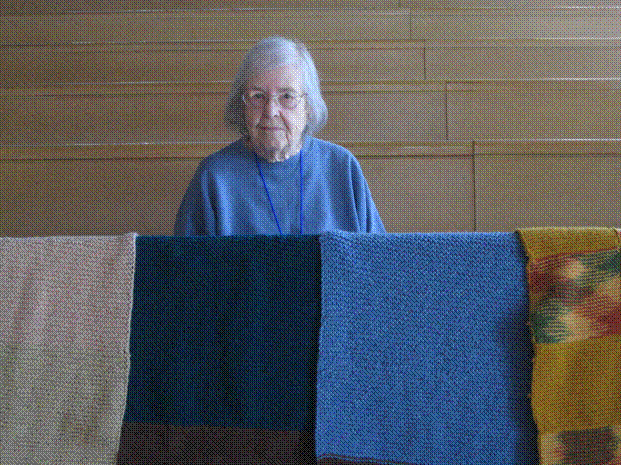
I think one of the million or so things I've learned in during my time at First Christian is that church is about this wonderful and odd collection of people who come together weekly and share their concerns and insights with each other.  I've seen true community happen.  I see 90 year old women make a prayer shawl for someone they thought needed prayer and a warm blanket.  I've seen men and women welcome a first time visitor and treat them like family.  I've seen the women of the congregation come and celebrate the arrival of a newborn even though the mother (and father) aren't members and they don't know the couple super well.

Maybe it's cool to talk about how you can find God in sunsets (I can find God there too, so you ain't special, sunshine), but the church is one of the last places were we can be a true community and it's the only place where we can learn about God from the lives of others.

The church isn't perfect, but I don't know what is.  But I do know that every faith community is a wonderful jewel filled with people trying to learn to be Christ to each other.  That's truly interesting and inspiring.

Saturday, September 03, 2011

Can We Just Be Church?

The writer of this blog post is writing from a Methodist perspective as well as from a local viewpoint, but I think there are a lot of people who feel this way:

Generally speaking, there is a perception in Springfield that there are only two options in choosing churches. The first I will call “evangelical.” Congregations of this option are perceived as large churches with relatively newer and fancier facilities. They are perceived as younger, comprised of families with school age children. The perception is that they are conservative, and focus exclusively on one’s personal relationship with Jesus and getting into heaven when one dies.

The second perceived option I will call “social justice.” It is perceived as the alternative to “evangelical.” Congregations of this option are perceived as smaller in size with older or more basic buildings. The perception is that they are comprised of older people, retirees and empty nesters. They are perceived as liberal, and focus exclusively on helping people who need help and making the earth a better place in this lifetime...

...A dynamic of these two prevailing models for congregations in Springfield is that people who associate with one tend to view the other in very generalized, stereotypical ways. The atmosphere in this community is highly polarized; there seems to be a strong either/or mentality in the Ozarks that predominates the public discourse. This trickles into the church culture as well. While the truth is far more nuanced, it seems that Christians in Springfield are labeled either an evangelical or a social justice type...

I have witnessed a spiritual hunger in this community for church-without-agenda. “Can’t anyone just be church?” is a question posed in some form in multiple conversations I have had with people who are not a part of a congregation. And a church “just being church” takes only one agenda as their own - God’s agenda - for which another term could be God’s mission, the mysterious and transcendent Missio Dei. God’s mission is made known in Christ Jesus, who not only came to announce the mission and undertake the mission, but to embody it. The mysterious and transcendent made flesh and blood in Jesus of Nazareth.
Since I'm an out, gay pastor, there are folks who probably think I have an agenda.  There are others who have an agenda and don't like my perceived agenda. 

But the reality is, I wish we could just be church.  I wish those of us who call ourselves Christians would learn how to love each other, even when we disagree. 

Of course, that would mean actually trying to follow Jesus, something that I think we fail to do, no matter which side we come down on.

Is "The Help" A Modern Tale on Materialism?

So says, Elijah Davidson:

The Civil Rights Movement of the 1960s serves as the backcloth for The Help, but I did not walk out of the theater with a renewed commitment to racial equality. I left deeply appreciative of women and deeply disturbed by how women are affected by our materialistic culture. To reiterate, The Help, I contend, is not about racism. It's not about sexism either. I saw in The Help a depiction of the destructive power of materialism.

The Help's villain is Hilly Holbrook, a racist, vindictive woman portrayed with vicious glee by Bryce Dallas Howard. Hilly reigns supreme at the apex of Jackson's social pyramid. She is the one lobbying for mandatory separate restrooms for blacks and whites. She is the one who excludes other white women who she feels don't belong in proper society. She is the one whose comeuppance symbolizes victory for the maltreated and misused. The audience is supposed to hate Hilly and all for which she stands.

It worked. For the first hour and forty-five minutes of the film, I hated her with passion. Then I realized the sadness and desperation of her own life. Hilly does not sit enthroned atop a gleaming pyramid. She reigns over a travesty. This is a truth not lost on the filmmakers themselves, as they make clear in Hilly's final confrontation with Aibileen.

Hilly is so desperate to keep everyone else down because all she has is her little self-created kingdom of social standing and wealth. Everything she does is an attempt to shore up the walls of this kingdom. She organizes "coat drives" to remind herself that she is not poor. Her women's committee lies to itself about making "a big dent" in African hunger. Her crusade against the housekeepers is born out of guilt that she is incapable of keeping her house on her own. She must denigrate the black women around her because they are ever present reminders of her own inadequacy and the weakness of her way of life.

Appearances are everything to Hilly and her covey of similarly self-interested wealthy, white women, because appearances are all they really have. The shocking revelation contained in the housekeepers' book isn't that racism runs rampant in Jackson society. It's that Jackson society is a sham.

The white women in Jackson are nothing without their housekeepers. They cannot cook. They cannot clean. They cannot take care of their children. More so, even with those responsibilities shoved off on their housekeepers, The Help demonstrates that the women cannot maintain their way of life, the deeper irony being that the oppressors (the white women) are themselves oppressed by the culture of Materialism.
 I will agree with Elijah that there is something in the movie about serving the gods of materialism, but I still think The Help is a story about racism.  Thankfully, the racism depicted in the film is now more a piece of history than it is the day to day life of black folks.  But in the end, this is story about America's recent past which had some racist bits.

It's also the lived history of a lot of living African Americans like my father, who grew up in Jim Crow Louisiana.  I remember recently hearing one of my older cousins who was born in Louisiana in the late 40s talk about his experience receiving care in charity hospital in Central Louisiana and let's just say the care wasn't top notch.

I'm not saying that materialism is a part of the story in the movie.  But this movie is about racism and how it affects the people in that situation.  I think that needs to be acknowledged and not downplayed.

There is one thing I totally agree with this take on The Help.  It's one of the final scenes that seems to me reminiscent of communion:

The scenes I found most poignant, though, were a scene in which Aibileen's friend and co-conspirator Minnie is presented with a feast by her employers and an immediately following scene in which Aibileen's church community applauds her and the risk she has taken to tell her story. I was struck then with the conviction that all women deserve a feast, and all women deserve applause for what they have done both to sustain us and to set us free.
Minnie ends up working for a white woman who is a bit of mess.  She can't cook and is shunned by the other women in Jackson.  The relationship that develops between the two outcasts is wonderful and the closing scene is one where the woman learns to cook and she makes a massive feast for Minnie.  The scene shows a white woman and a black woman sitting down together to eat a wonderful meal.  If that isn't a demonstration of what communion is all about, I don't know what is.

Thursday, September 01, 2011

"The Help"

My partner and I recently saw "The Help," a hit movie that takes place in Civil Rights-era Jackson, Mississippi.  I have to say I was pleasantly surprised by the movie.  I didn't think it would be any good, but it was able to tell a good story about the lives of upper middle class white women and their African American maids.  There are a lot of movies that have tried and I think failed to tell the story of the civil rights movement (I'm looking at you, Mississippi Burning), but this one got the story right.

Presbyterian pastor Paul Moore did a good job of a giving a review of the movie.  Here's what he said after watching the movie with his young daughter:

I’m glad Hannah watched “The Help” with me. It gave us a chance to leave a world that values Facebook and brand clothes to talk about issues that really matter. There was something at stake in what happened in the movie. Skeeter, Aibileen, and Minny didn’t change the world, but they shared stories that illustrated the ugliness of their age. Their courage transcends time. 

I don't really want to use the word "feel good movie," because well, the times were not feel-good.  But you do leave feeling that there are some courageous people in the world and some of them might be sitting right next to you.  Go see the movie, you'll be glad you did.

Tuesday, August 30, 2011

We Need This

Interesting words from Lutheran minister Nadia Bolz-Webber:

I need to receive the Eucharist. I need to hear the gospel again and again and again, because I forget all of that. I think that’s what we do in Christian communities. We gather. We remind each other of who we are. We remind each other of God’s promises, and that’s what we proclaim.
I think people, especially liberals, conflate sin with low self-esteem. They’re like, “I don’t want to talk about sin anymore,” because [they’ve been told] sin is immorality. They’re like, “I’m tired of having someone tell me I’m immoral when I’m not.”

There’s very little to do with morality. Sometimes it intersects with morality -- absolutely, no question. Being curved in on self can cause some really immoral things.

If you could actually manage to be a completely ethical and moral person, you would still be sinful. It doesn’t mean you’re bad. It just means that God is God and you are not, and that’s actually good news.
I once visited this woman who had a 6-month-old baby die. I spent the day with her. She had a pack of cigarettes next to her bed, and she didn’t have custody of her other four kids, and she was a drug addict. She spent the whole time going, “You know, this all happened because of this cop or this social worker who had it out for me.”

She had this totally external locus of control. I was so sad after I left, and it wasn’t because of the situation, which was sad; I was sad because I felt like she was never going to experience the exquisiteness of God’s grace, because she can’t confess. She needs it, but she can’t get to that place. She’s not going to have the freedom that comes from that, because she keeps going, “No, it’s this, it’s that.” Total denial.

My church always has a confession and absolution at the beginning of our liturgy. A lot of church planters want to jettison the confession, because they don’t want people to feel bad. I’m like, “Oh my God, that’s central to who we are.”

As I was greeting a woman who has been a long-time visitor, she said one of the reasons she comes to our church is because of the communion.  The tradition that I've been a part of for nearly 15 years, the Christian Church (Disciples of Christ), places a lot of emphasis on communion...at least in theory.  But like most anything, I think we forget the importance of this act, this act of having fellowship with a God that knows us completely, especially when we mess up, and still loves us.

We need this meal.  We need to be reminded how we fall short and how God still loves and redeems us.  While we don't do confession and absolution, the Lord's Supper is kind of that all in one. 

I am reminded of my Lutheran seminary days where a professor said in a sermon that people want the gospel, they want to hear the good news.  They don't want tales of bunny rabbits, the want the gospel.

We need to hear that we are loved and forgiven by God and we need to see that in action through communion. 

I need this.  You need this.  Don't forget that.

Sunday, August 28, 2011

Life of Brian at 30

Tony Jones links to a comment about the Monty Python movie.  I happened to see the movie for the first time on a Good Friday evening.

Yeah, I know: I'm so going to hell. ;)


Sunday Sermon: August 21, 2011


“Think Different.”
Exodus 1:8-2:10 and Romans 12:1-8
August 21, 2011
First Christian Church
Minneapolis, MN

Earlier this week, the political world was abuzz about an op-ed by investor Warren Buffet.  In the opinion piece in the New York Times, Buffet calls on Congress to “stop coddling the super-rich” and raise taxes significantly on persons like himself who happen to be super rich.

As someone who follows politics, I can tell the reaction was rather predictable.  Many on the political left cheered it, while conservatives thought that if Buffet thought he should give the government more money, then he should do so without asking for Congress to raise taxes.

I’m not here this morning to talk about Warren Buffet’s challenge or to argue the finer point of American taxation.  What I am interested in is something that Buffet talks about  at the start of his opinion piece: a call for shared sacrifice.  It’s a phrase that we hear a lot from politicians.  For Buffet the answer to is one of the upper incomes paying more in taxes.  That’s a political and economic answer to our ongoing problems with the economy and the deficit.  But what does it mean for us?  What does it mean for those of us who follow Jesus?  What does shared sacrifice look like?

Thursday, August 25, 2011

1,2,3,4,5...1,2,3,4,5...1,2,3,4,5...

Every so often, I happen to watch the TV series "Haven."  Last week's episode spoke to me because it talked about a character with Obessive Compulsive Disorder.

Titled, "Audrey Parker's Day Off, " has our lead character reliving the same six hours over and over ala "Groundhog Day." In each instance she sees a different friend get killed by a hit-and-run driver.  She tries to do what she can to prevent the accident from happening, but she keeps seeing her friends die. 

Towards the end of the show, we find out that the reason she is living these hours over and over is because of one man who happens to have OCD.  Anson is a man whose marriage broke down over his condition and because he thinks he caused the accident by not counting the right way or what have you, his guilt basically "resets" time and keeps Audrey dealing with the same day over and over.

The Anson character is either counting the numbers of buttons on his shirt or wondering if he should touch the phone and so one.  A choice that might seem inconsequential to most folks causes him sheer pain.

The time loop ends when Anson in a way frees himself from the guilt and chooses to step in front of the speeding car, which kills him.

I bring this all up because this display of OCD is all to real for me.  Aspergers can come with other conditions which are considered co-morbid and for me, one of those is OCD.  Over the last 10 years or so, my struggle with OCD has been tamed with medicine, but it can still pop up.  Daniel notes the times I tend to wash my hands more than once.  But it was worse before I was medicated. I can remember trying to go to bed and getting up again and again to check to see if a rag was on the stove or I had turned on the stove thereby filling my apartment with gas.  I would do this so much that I then could not get to sleep because I was now just filled with worried.  When I was younger (high school days), I would fear that I had hit someone and would even turn around to see if I had struck down a person.

I could share other stories, but I think you get the picture.  I know that writing about this might give people the impression that either a) Dennis is just a nut; or b) that I am drawing attention to myself.  I guess I just want to share this with folks. For a long time I didn't share out of shame and probably because yeah, people would think "wow, Dennis is just nuts."

But the thing is, a lot of us deal with this.  Some of us have forms of autism and this kind of comes with the package.  It's not easy, but the thing is, we do get by and can still lead normal lives. 

So if we meet somewhere and I get a bit fixated and start washing my hands a lot or something, just be patient and nudge me a bit.  I'll get the message.

And I'll keep taking my medicine.


When An Aspie Get Invited to Dinner

...kind of describes my own social anxieties.

Thursday, August 18, 2011

An Uncertain Trumpet

Several years ago, I was at a local GOP convention through my work with Log Cabin Republicans.  As I was going about meeting folks, I realized that a gentleman from a church I used to belong to was a delegate to the convention.  It was nice to see him, but it was also interesting since this man never talked about politics in church and as far as I can tell, still does not today. 

It was interesting that I never knew the man's party affiliation.  It never came up in discussions.  He's always been a straight arrow dealing with financial and legal issues facing the church.  Politics just never came up in most conversation.

I share this because I am reminded by a post by Episcopal blogger Fredrick Schmidt about American Christianity and where it intersects with today's politics.  More and more, I want to be like this gentleman that I know, keeping politics out of the life of the church.

I'm not suggesting that the church should just not be involved in caring for the poor or speaking out when need be.  But I am saying that our involvement in politics has not as much elevated the body politic as much as it has brought the church down the to level of crass partisan bickering that we see so much of on TV and on the web these days.  The church is mimicking what we see on Fox News or MSNBC and acting accordingly. 

Schmidt is not amused and he calls for Christians to be willing to pursue the truth no matter where it leads:

Christians are no better at navigating the American political landscape than anyone else. The name-calling among them may have a religious ring to it, but it is depressingly similar to the tribal incivility on display everywhere else. And, sadly, when we are commenting on the larger political drama we drop the religious language and we are as nasty and unreflective as the talking heads on Fox or MSNBC. Some of the epithets I have watched Christians use in political observations on Facebook aren't even fit to reprint here.

For that reason, I am not at all sanguine about Christians transcending the terms of the current debate. That doesn't speak well for the rest of the claims that Christians make and that's deeply troubling.
Christians will necessarily commit themselves to a point of view, but they should all be committed to the pursuit of the truth, wherever it leads. They should be tenacious about gathering the facts. They should be scrupulous about avoiding distortion. They should be committed to civil and incisive debate about the issues. They should foreswear name-calling and character assassination. And they should be capable of considering solutions to the problems that face us that lie outside the ideological parameters on both the left and the right. If we can't do that, we really add little or nothing to the public debate.


But the problem facing the churches is the same that is so common in our society today: our insistence on being right instead of being loving.  Conservative and liberal Christians are sure that they have the answer to public policy questions and the other side is not only wrong, but probably not Christian.  Conservative Christians mimic their big brothers and advocate against tax increases and supporting what they see as "big government."  Liberal Christians follow their siblings, calling for taxing the rich and for the continuation if not enlargement of the welfare state.  Each side finds a few Bible verses to justify their side and condemn each other.

That said, we also face a far bigger problem: we want to believe that God is on our side and ours alone.  And there we definitely reach for our Bibles as weapons.  Schmidt says we can't expect the Bible to justify our position:

First, there is probably nothing in the Old or New Testament that can be applied directly and unequivocally to the debates that we are having. Ancient Israel was a theocracy with a king. The early Christian community was a church, not a country. The early church described in the Book of Acts was a minority movement within its own world. Its members did not exercise responsibility for shaping Roman policy. They did not issue currency and they did not elect representatives. So, we live, work, and vote in a completely different environment than those in which the books of the Bible were written.

We can debate the merits of big government, the size of federal budgets, the structure of the tax code, and the advisability of creating a welfare state. But the early Christian community described in the opening chapters of the Book of Acts, in which "all things were held in common and no one suffered need," is not a model for nation-building and it is not a model for creating a thriving, modern economy. To suggest otherwise is to rely on sloppy exegesis and anachronism. It is logically misleading and romantic nonsense.

What I wish to see in the modern American church is not a bunch of "red" and "blue" churches, but communities that seek to follow Jesus and are engaged in thoughtful discernment of public issues.  I want to see churches think about how best to help the poor, or spur economic growth, or what should be the scope of American foreign policies than just parrot what Rush Limbaugh or Rachel Maddow said that day.  I want to see communities where liberals and conservatives can talk about these issues knowing they don't have all the answers.  I want to see a church where we are humble about our political beliefs and willing to rest on God's grace and mercy instead of the Democratic or Republican party platform.

In the end, I'm not asking that Christians never talk about politics or their ideology.  I am asking that we model a different way of being in the world, that we learn to be Christ to each other instead of demonizing each other the way the "pagans" do. 

In some ways, this has made me an uncertain trumpet.  I'm not as willing to sound the horns for battle like I used to.  Yes, I have my opinions and as a political blogger, I do express them.  But as a Christian, I want to exhibit something a bit different.  I want to be about community and love, instead of being right.  Life is about loving our friends and fellow Christians even if we can't agree with them.  It's about loving as Jesus love.  That's a trumpet I want to sound anytime.

Tuesday, August 16, 2011

The Backwards Church

A story about how a child with autism was welcomed into church:

Finally, when Max turned 13, I could bear it no longer. I brought him back for the one thing he always loved about church when he was a toddler: when it was over. So, that’s exactly when we showed up. We called it “backwards church.” People were pouring out of the sanctuary and we walked in! It was the coffee hour, which at our church feels more like a backyard barbecue — friends talking and laughing, children playing Nerf football. Max fit right in. But something else was going on: God was about to grab his spiritual tool belt.

Within minutes Max started helping some of the men who were stacking chairs in the sanctuary. Before we left, one of the men approached Max. He put his hand on Max’s shoulder and asked if he would like to be an official member of the “Grunt Crew,” the team of men who clean and stack the chairs after each service. Max straightened his back and gasped with a rush of air so cool and cleansing that it felt like menthol. One small invitation, that one touch, changed our lives and the life of our church. For six years now Max has been a member of the Grunt Crew. He’s even become a greeter, which for Max includes leaping and dancing when the worship music begins. Max still doesn’t sit through the service, but his joy in serving is contagious. And he is a vital part of our church. It’s as if being with Max, this boy without armor or pretense, who knows the privilege of church, lets us all feel a bit of victory too.

Monday, August 15, 2011

Putting Your Taxes Where Your Values Are?

Alan Brevere makes a good point regarding Warren Buffet's op-ed on taxing the super-rich:


I like Warren Buffett. I admire him. He has been very generous with his money over the years. But when mega-rich folks like Buffett write editorials arguing that the wealthy should pay more in taxes, I am always puzzled by one thing. If he thinks he should pay more why doesn't he just do it? He could, for example, not take those tax breaks that the government allows him to take. There is no law requiring Buffett to do so. Or he can actually make a contribution to the federal government. Instructions on how to do so are right on the website of the Financial Management Service, which is a bureau of the U.S. Department of the Treasury...

It's one thing to write an editorial stating what others should do. I would suggest to Mr. Buffett that if he is serious about his words, he will back them up with action. Uncle Sam has his hand out and will not reject his check. I highly doubt that he will even ask Warren for two forms of ID.

When I stand up in front of the folks in church on Sunday morning and I encourage them to tithe (which should be the minimum gift to the church, not the maximum), I better be tithing and more myself. Otherwise my words have no integrity. If I insist that individuals read their Bibles and pray, I better be doing so as well.

I should add here that I agree with Alan that taxes probably need to be raised, though frankly I'd like to know why we want to raise taxes.  Buffet simply says taxes on the rich need to be raised, but then does not explain what this increased income is for?  Will it pay for social programs?  Entitlements?  Stem the debt?  We don't know.  All we know is that the rich need to pay more.

That said, I think Alan's charge that maybe Buffet should put his money where his mouth is makes some sense.  I used to think this was just a useless charge from conservatives, but not any more.  Of course, Congress and the President have to duke it out in raising revenue, but nothing is stopping Buffet from making a donation in the meantime.

The issue of taxation is one that we as a society must debate.  But if people are going to make such statements as Mr. Buffet's, maybe they should also make sure they are practicing what they preach.

Tuesday, August 02, 2011

Jesus for President?

Like it or not, Jesus is running for political office.

Jesus has been running for office for quite some time now.  What's his platform, you say?  Well, it's whatever happens to be your political pursuasion.  Are you a Democrat?  Well, Jesus is about as blue as can be, supporting government programs and very much for raising taxes on the wealthy so they can pay their "fair share."

And if you are a Republican?  Well, Jesus is a super patriot, is against raising taxes and government spending.

You can probably see where I'm going with this. 

In light of the recent budget and debt mess that has finally be resolved, I've heard folks talk about how it's not simply wrong, but downright sinful to cut any social programs.  I've also heard others try to infuse their conservative fiscal agenda with holy talk as well.  I hear people talk about "What would Jesus cut," as if Jesus was somehow involved in social policy during his time on earth.

Being a mainline Protestant pastor, I've hung out with other pastors who are decidedly on the liberal end of the spectrum.  The way they talk, you'd think Jesus came to earth to give every Social Security and Medicare.  Conversely, conservative Christians have somehow made raising taxes some kind of mortal sin that should send one to the very gates of hell.

I'd like to give my sisters and brothers who are partisans a little advice: stop using Jesus to prop up your arguments.

Jesus walked on earth during the first century, long before there was anything like a welfare state.  Jesus didn't have a position on Medicaid or defense spending.  Last I checked Jesus wasn't issuing his view on US tax policy. 

Jesus did care for the poor and  called us to do so as well.  But you might notice that Jesus never said how that should be done.  Maybe Jesus was smart enough (or extremely gullible) to believe we could figure that out.

I think there are good and moral arguments both for and against government programs aimed at alleviating poverty.  I think there are good and moral arguments both for and against raising taxes.  Jesus didn't call us to support this or that ideology; Jesus called us to be faithful.  We have to discern how to be faithful to his call to care for the least of these and odds are we will come to different conclusions.  That's okay. I think God is a god that likes to give us a wide berth to come up with how to be faithful.

So, can we please stop asking what Jesus would cut or not cut and stop trying to make Jesus some kind of mascot for our political parties?  Jesus came to give us abundant life, not free health care or lower taxes.

Tuesday, July 19, 2011

Why Do We Hate Rupert Murdoch?

I've really never understood the amount of animosity towards media mogul Rupert Murdoch and now that he dealing with the current scandal in the UK over phone hacking, some of these "Rupert haters" are now dancing with glee. The New York Time's Joe Nocera, who usually is an even keeled columnist, is enjoying how the hunter has become the hunted:
Let’s be honest here. There is something undeniably rich about seeing the tables turned like this. When I see photographs of Brooks, or Murdoch, or his son James (who until a few weeks ago was his father’s heir apparent at the News Corporation), sitting in their cars, staring blankly ahead, I can just picture the paparazzi horde jostling to get a decent shot of its prey. Murdoch’s papers have always feasted on scandals like this, picking the bones of their victims. Now Murdoch’s the one whose bones are being picked...

“The schadenfreude is so thick you can’t cut it with a chainsaw,” wrote The Wall Street Journal in an editorial on Monday, defending Rupert Murdoch and the News Corporation. (That’s right. After woefully undercovering the scandal in its news pages, The Journal’s editorial page is now leaping to the defense of its owner. Proving, yet again, that The Journal knows where its bread is buttered.)

Well, yes, the schadenfreude is pretty darn thick. Who would deny it? The whole thing reminds me a little of the ending of Ian McEwan’s wonderful novel “Solar,” in which the many awful things the central character has done in his long life suddenly come together to bury him in an avalanche of comeuppance. I’m O.K. with that.
Nocera then lists the sins of Rupert Murdoch, number being Fox News:
Although I generally admire entrepreneurs who build giant companies, Rupert Murdoch, despite giving us Homer Simpson, generally has not been a force for good over the course of his long career. His Bill O’Reilly-ed, Glenn Beck-ed Fox News has done a great deal to coarsen the political discourse. His tabloids have lowered the standards of journalism on three continents — and routinely broken the law on at least one of them. He had dumbed down his prestige papers, like The Times of London. He has run roughshod over cross-ownership rules meant to prevent one man or company from having too much power — and then used his lobbying might to get those rules diluted. He has put kowtowing to China ahead of freedom of the press, even killing a book set to be published by his HarperCollins unit that the Chinese authorities objected to. He has consistently used his media properties to reward allies and punish enemies. It’s a long list.
While I think it's important to look into the phone hacking mess to find out how far up the corporate chain it went, I think it's a tad premature to tar Murdoch with all of this, as if he order folks to hack into phones.

One of the sins that Nocera mentioned is the advent of Fox News and how it has cheapened the public discourse. I'm not a fan of Fox News, but I have always said it has to right to exist. If people don't like Fox they can just ignore it. Also, its not as if political discourse was some kind of Eden before Fox. Fox News is just a symptom of a greater disease, and if it were to disappear tomorrow, we wouldn't all go back to being nice with each other.

All of this hate and schaudenfruede is a bit much. And frankly, at the end of the day it makes those that enjoy it look somewhat small and petty.

Maybe Murdoch is guilty. Maybe he did know what was going on at News of the World. If so, then he should pay the penalty.

But we don't know all the facts. Instead we want to see someone squirm simply because we don't like them.

I don't think that's right.

Wednesday, July 13, 2011

Repost: The Old Man and the Queen

This post is from 2008. One note: when this man dies, I will be at his funeral.

And I will cry.


As several denominations struggle with the issue of gay pastors, I am reminded of something that happened to me a few years ago.

I had just graduated from seminary and was doing my CPE at a local nursing home. I was still involved at the church where I was an intern and was asked to serve on the church board. It came to a vote and I was voted in nearly unanimously. I say nearly because one person voted against me. I knew who it was and so did many others. It was an elderly member of the church. He had some idea I was gay and many people assumed that was why he voted against me. After the meeting concluded, he asked me to come with him into another room. He explained that he prayed and studied the scripture on the issue of homosexuality, but his conscience was not swayed in favor. As he said this, he began to cry.

I was and still am touched by this guesture. He did have to speak to me to explain his actions, but he did. He might not approve of who I sleep with, but he did treat me with respect. This wasn't simply about being right for him, but about being loving.

Yeah, I know that his actions were hurtful. Yes, it would have been nice had he voted in favor. But I could respect his decsion even if it was wrong, because he valued me enough to respect me.

Why am I sharing this? I guess because sometimes those of us who fight for justice for GLBT folk tend to paint everyone and anyone who might disagree as evil and backward and not worth listening to. Many pro-gay people think saying anything that is against being gay is hurtful to gays and react strongly to anything that might be hurtful to gays.

But the thing is, there is a difference between words and people that do mean to harm and those that are just not there yet. There are people that truly hate gay people, but not everyone who might have an opinion opposing gay marriage or gay ordination is necessarily a bigot. And the fact is, I'm a big boy-I can handle an old guy.

I truly believe we must work for justice and inclusion in the church. But grace has to be part of the plan. The old man's opposition was tinged with grace and for that reason I could also respond in grace.

I still see the old man-he is now in his late early 80s, but still going strong. We are friendly to each other and he still treats me with the utmost respect and even sees me as Biblical scholar (?). And I love his tenor voice-which is still strong after all these years. I have no idea how he feels about me being gay or having a husband. But I do know that he has taken the command of love very seriously and I will truly weep the day this man leaves the scene. He has taught me about grace; and for that I am ever thankful.

Great, now I'm tearing up...

Graceful Conversation

I think in our day and age, we are losing the act of conversation.  It's kinda odd, in this time when we have so many ways of talking to each other, we really don't talk to each other, at least we don't talk to people who we happen to disagree with.  Instead, we stay in our little circles, unwilling to actually listen to someone who might disagree with us.

It's interesting being a moderately conservative guy in a room full of liberals.  At some point the conversation gets wanders around to someone like Sarah Palin or Michelle Bachmann and everyone takes turns knocking down Republicans.  I start to get a little uncomfortable at all the trash talk.  I have to believe that the same thing goes in conservative circles.  Woe is the lone liberal that has endure that experience.

The sad thing these days is that we really don't know how to listen and talk with each other.  We seem to forget that each person is a child of God and so we hurl invectives at the other camp.  We are so full of righteous indignation that we are blind to loving our enemies.

As Christians, we need to learn to have conversations.  I guess it's kind of ironic that the person who has trouble with conversations is the one bringing it up, but there you go.  Yes, there were times that Jesus got angry, but there were also times that he listened to people.  At times, we have to learn to give up our need to be right, our need to be angry to learn to love the other- especially when we disagree with them.

Presbyterian pastor Janet Edwards wrote a wonderful post on conversation with adversaries, especially when it comes to GLBT issues.  Here's a snippet:

  1. Approach the other person as a beloved child of God. See Christ in the eyes of the other person. Set aside every presumption you may have about him or her except that God loves this other, just like God loves you. This is often a mystery for me that our talk with help solve.
  2. Trust deeply that the Holy Spirit has a word for you both. Watch carefully for the gift God has for you in your exchange with this other. It probably will not be the same gift for both of you. It will most likely be a still, small voice so you must listen hard for it.
  3. Try hard to see things from the other’s point of view. Ask questions like: “This is what I hear you saying, is that correct?” or: “I want to make sure I get what you mean, is this what you said?” My own convictions have been strengthened many times by testing them against the other’s heartfelt words.

I think these words are important, especially for those of us that are gay, lesbian, bisexual or transgender. We have to be willing to hear for the Spirit speaking even from those mouths of those we disagree with.

I don't think any of this is easy. But then, no one said following Jesus was easy.

Monday, July 11, 2011

Who's A Feminist?

I know I will probably stir some kettles with this one...

About 15 years ago or so, I remember listening to a call in show on public radio that talked about women's rights.  At one point a caller called in and talked about a friend of hers that was in many ways a strong feminist except that she was pro-life.  The caller asked if this woman would be consider a feminist.  The guest on the program responded: no, she could not be considered a feminist because of her stance on abortion rights.

I remember being rather shocked about that.  I can understand not agreeing with someone on that topic and I can see myself (I am pro-choice, by the way) have some issues.  But I didn't think this one issue should disqualify a woman from being...well, pro-woman.

There's a post up at the Her.menutics blog (one of many blogs from the evangelical magazine, Christianity Today), that talks about "evangelical feminism" in light of the prominence of two women in political ciricles, Michelle Bachmann and Sarah Palin.  Now, I'm not a fan of either woman.  I strongly disagree with Ms. Bachmann's anti-gay views and I agree with former Minnesota governor Tim Pawlenty in that the congresswoman hasn't done much during her time in Congress.  I think Palin does have some smarts, as evidence in this recent Atlantic piece, but I think she decided to play the role of outsider instead of competent governor.  I know it might distrub folks to see these folks as feminists, but in a way, they are.

Before people start throwing tomatoes at me, let me speak.  What I am trying to say here is that both women are very strong, opinionated women who have worked hard to get where they are.   I might totally disagree with their views, but these are not the stereotype of conservative women that hide behind their strong husbands. 

Does that make people especially my liberal feminist friends, uneasy?  Yeah, it probably does.  But then maybe we need to think again about what feminism means.  If it only means being pro-choice, then you have made it the same narrow kind of club that we accuse conservatives of doing.  However, if there is a diversity of ways of being a feminist, then maybe people can come together on issues where they agree to continue to uplift the role of women in society.

Okay, just let me get my umbrella.  Now you can throw your tomatoes at me.

Thursday, July 07, 2011

Autism and Sex

I know it might be bad form for a pastor to be sharing an article about how people on the autistic spectrum achieve an orgasm, but since there are a lot of us out there that will find a partner or spouse, it's probably a good idea to share this.  So, read it.

Wednesday, June 29, 2011

"My Gay Marriage Harms Nobody"

The following piece is something I wrote for the political website FrumForum as a response to another author concerning the passage of same sex marriage in New York State. 


On September 15, 2007, I got married.

It was a pretty normal, run-of-the-mill event — as weddings are. It was held in a small, picturesque Episcopal Church outside of Minneapolis. The sanctuary was decorated with flowers. The families of both parties were there, beaming with excitement. The only thing that might not make this event a typical wedding was that I was getting married to another man: my partner, Daniel.

At that wedding, we pledged to be faithful to each other. Our relationship was blessed by the Episcopal priest and those gathered, including both of our parents. Our wedding (and Daniel was insistent we call it that) was soley religious, since Minnesota doesn’t allow for same-sex marriage. At some level, it didn’t matter that our marriage was not recognized by the state. It was important that we made a committment to one another in front of the gathered community and in front of God.

But a year later, it did matter.

Keep reading...

Photo: Engagement photo of Daniel and myself.

Monday, June 27, 2011

Sermon Podcast: June 19, 2011

June 19, 2011 (Trinity Sunday)
Texts: Matthew 28:16-20 and 2 Corinthians 13:11-13

Click below to hear the sermon.

Sermons @ First Podcast: June 19, 2011

Thursday, June 23, 2011

Aspies and Grief

Gavin Bollard has a great post on his blog regarding how persons with Aspergers grieve.  Maybe one of the big things about those of us on the autistic spectrum is that we don't have emotions.  The reality is we do have emotions, but they are expressed very differently than most neurotypicals.

Gavin shares a recent trauma, how it affected him and how others were affected by him:


We all deal with strong emotions, such as love, anger and grief in our own ways. My wife tends to cry things out but I often internalise them and take them on board as stress and at times, self-harmful behaviour. In the kids, these emotions can manifest as meltdowns or as general destructive behaviour. Sometimes there's nothing to see on the surface at all.

The point is that although we each feel these emotions and we feel them at similar strengths, our reactions vary widely both in intensity and visibility...
 
For some reason, our society seems to think that it's okay to quantify emotions based on visible reactions. If an event occurs to two people and the woman is crying while the man is not, then the woman needs the most care and attention because "she's the one who is really hurt". The solution is to talk in a quiet voice and bring lots of cups of tea and chocolates.

The man, by contrast isn't bawling his eyes out, so he's obviously not hurt. There's nothing that you need to do for him. There's no need to tread lightly because "he's not even upset".

In fact, if the event is of an appropriate level, for example the death of a loved one, then anyone not outwardly grieving is "fair game". You can take things out on them and you're more or less expected to say "what's wrong with you man?". The words "you don't care" should also be used in conversation to him.

Sound familiar?

It's something that many neurotypicals do and yet so few realise how wrong it is.
 Gavin's point is that just because someone is not crying doesn't mean that they are not feeling any emotion.

I saw this a few days ago and was planning to write something about it.  Like Gavin, life stepped in a provided an object lesson.  Late Wednesday evening, my Aunt Nora died.  For the last five years, she suffered the horrible affects of Alzheimers and was being taken away from her loved ones bit by bit.  I've known this woman since I was a baby, so of course it is sad to me.  But, I'm not really bawling my eyes out.  I'm rarely the one that is overly emotional in times like this.  For a long time, I wondered if something was wrong with me.  It's not that I didn't feel sad- it's just that I didn't react in the same way others did.

We live in this world where we expect people to grieve in a certain way.  But there isn't one way to grieve.  Those of us on the spectrum do feel sad and sometimes we can feel sad in ways far stronger than neurotypicals.  But we don't show it in the way that others do.

I think about this as I think about my Dad.  All of his sisters and brothers are now dead and he's the last one.  I know that he is grieving, but typical him, he doesn't show it.  I don't think this is because he is autistic, but he is the typical male of his era.  

But as someone that doesn't express emotion like others, I do understand and I will let him grieve in his own way.

Sometimes the tears don't show on the outside, but they do appear in our hearts.

Welcome to Theobot!

I think I forgot to tell folks that I now I am writing a lectionary blog called Theobot.  Don't expect sterling Biblical scholarship, but do expect some musings from a guy trying to figure out what God is saying in these texts. 
 
Check out the link to this week's post on the Old Testament text.

Tuesday, June 21, 2011

"Progressive Christians" and Yours Truly

I've been noticing lately within Mainline Protestant  circles, the rising use of the word "progressive" as a way to describe Christians who might have once used the term "mainline Protestant."  The biggest change to note is over at the religion megasite Patheos, which changed the name of one of their religion portals.  What was once called "Mainline Protestant" is now called "Progressive Christian."  That change has brought about a discussion of the term and there have been some fairly good posts about name change.

That said, I'm also a tad bit wary of the term.

Sunday, June 19, 2011

Retreads: Change We Can Believe In

I wrote this blog post in March of 2010 on how persons on the autistic spectrum don't like change and how that relates to the modern Mainline Protestant congregation.


In my short time as an ordained minister, I am finding one the most challenging things to take on is congregational transformation. It's one thing to plant a church, quite another for a 133 year-old church to change some of the things its been doing.

In my 17 months at First Christian, I know that people approach change with fear and trepidation. It's scary. It's the unknown. It might lead to people leaving the church.

Change is scary because it wrenches us out of our well-worn ways of doing things. It takes us out of our safe routine. It's just damn uncomfortable.

Believe me, I know. I don't like change.

It's funny how this fear of change so relates to me, especially since my Aspergers diagnosis. One the traits of this form of autism, is that I tend to follow some well worn ways of doing things. I don't like surprises. I don't like things messing up my ordered life.

So, of course I end up with a life partner that lives life at the spur of the moment.

For someone who is autistic and likes his very ordered life which calms him to have someone in your life who loves to be spontaneous can seem like a nightmare.

Sunday Sermon: June 19, 2011


“Go.”
Matthew 28:16-20 and 2 Corinthians 13:11-13
June 19, 2011 (Trinity Sunday)
First Christian Church
Minneapolis, MN


It was fifteen years ago, around this time that I preached my very first sermon.  In fact, it wasn’t to far from here at Grace-Trinity Community Church in Uptown Minneapolis.  I remember being so nervous.  I didn’t really enjoy public speaking and to some extent, it’s still hard for me.  I remember counting down the days until I preached.  I practiced the sermon with the pastor of that congregation who continually told me to speak louder and to try again, and again, which only made me more nervous. My parents drove in from Michigan to see me preach.  I don’t think I sleep that much the night before.  I can remember that Sunday going up to the pulpit and reading my sermon to the gathered congregation.  And I think I didn’t do that bad of a job.  At least that’s what everyone told me.  I’ve preached many times since that sermon in June of 1996, but I’ve never forgotten the emotions surrounding that first time.

What made me so completely nervous was the fact that I was getting up in front of people feeling oh so very naked and vulnerable.  I was sharing my life with other people and that just made me nervous.  Somehow, I was able to get though that sermon.

Saturday, June 18, 2011

Autism and Faith

I stumbled upon this blog post that offers tips for faith communities in becoming more welcoming to persons with autism.  There are tips for Christian and Jewish communities. And here is a post about autism within the Muslim community.

Monday, June 13, 2011

Sermon Podcast: Pentecost Sunday

June 12, 2011 (Pentecost Sunday)
Texts: Numbers 11:24-30, Acts 2:1-21

Here's what I preached for Pentecost 2011. Click below to hear the podcast.

Sermons @ First Podcast: June 12, 2011

Sunday, June 12, 2011

Sermon Podcast: Palm Sunday

I thought I'd start sharing some of the sermons I have via First Christian's podcast page.  Here's one from Palm Sunday of this year. Click on the link below to hear the sermon.

"To Be Continued..."

Thursday, June 02, 2011

The "Heresy" of Pacifism

A friend of mine and I had a very short talk yesterday about the use of the military and that got me thinking overall about pacifism in the church. Maybe it's just me, but there seems at times to be a kind of unspoken pacifism in the church. That in and of itself is not a bad thing in my view, I tend to believe every follower of Jesus should strive to deal with conflict in a nonviolent way. But it seems at times that the pacifism that is running around tends to be more ideological and less willing to deal with the situation at hand. In short, it tends to think more about the letter of the law and not its spirit.

In a perfect world, refraining from violence would be a perfect tactic in dealing with problems. But we don't live in a perfect world and the actors we deal with are not always rational actors.

In thinking about this question of war and the Christian faith, I did some surfing and stumbled upon the blog called the Row Boat by Nathan Schnieder. In a post written in 2009 entitled, "Niebuhr, Pacifism, Realism, Peacebuilding" he critiques Reinhold Niebuhr's essay “Why the Christian Church Is Not Pacifist.”

I have not read Niebuhr's essay (though I intend to). But I did like this review of the essay as well as some of Schnieder's criticism. Niebuhr's organizing take on the world, Christian Realism, is something that I wished was preached more in mainline Protestantism. There's a lot to dig into here, but I want to focus on Niebuhr's take on nonviolence. In short, we look at whether or not the nonviolence practiced by Ghandi was Christian or not:

Niebuhr asks how biblical modern nonviolence theory really is. In the first half of the twentieth century, peaceniks preached peace but generally lacked a method. But by the end of World War II, most believed they had found one in the work of Gandhi. The method of nonviolent resistance perfected in the Indian independence movement quickly began to take hold in the civil-rights struggle of black Americans. (For Niebuhr, as well as for Martin Luther King, the chief source was FOR member Richard Gregg, who lived with Gandhi in India before writing his classic The Power of Non-Violence.) Many Christian pacifists believed that Gandhi was in some sense a fulfillment of Christ’s promise.

Yet does Jesus’s scriptural example really have anything directly to do with Gandhian resistance? Jesus exhibited no interest in the overthrow of an unjust social order, beyond noting that its temples would crumble and its poor would always remain. He stood up for all sides of political divisions—centurions, tax collectors, oppressed Jews, and dejected prostitutes. Sure, he advocated taking blows without complaint, and did so himself; but he also spoke of swords and lashed out at merchants. Jesus’s witness was mainly pacifist, but it would be an exaggeration (and a disappointment) to say that this constituted Jesus’s essential message. Ascribing to him a Gandhi movement would be a stretch.
Schnieder then tries to explain Niebuhr's Christian Realism:

The sum of Niebuhr’s thought is often described as a Christian “realism.” It takes seriously the inevitability of sin and selfishness in human affairs, then seeks a set of social arrangements which provide a modicum of justice and the freedom for Christian witness to flourish.


Violence and war have a place in this. They have a certain necessity for him, though Niebuhr hardly had great confidence in their capacity for do-gooding. An adventure like the 2003 invasion of Iraq, which sought to transform a crumbling society into a model democracy through transformative violence, was hardly something he could get behind. But an intervention in Darfur against a coordinated genocide, more likely yes.
Some folks say pacifism is biblical.  But then again, as Schnieder says, genocide was also favored in the Bible as well.  In the comments, Schnieder explains a bit more how Christians who take nonviolence seriously should make decisions:

I also mean to agree with Niebuhr that Christianity doesn’t equal Gandhian political struggle. Yes, there are resources in the Bible to support it, but there are also resources to support genocide. Jesus’s own efforts seem much closer to anti-political pacifism than political resistance. The point is: I think nonviolent resisters have to take fuller responsibility for their commitments. They can’t just say, “This is what Christianity tells us all to do, so we have to do it.” Instead (and I think this is actually more empowering), they should say, “I am a Christian, and I have come to the conclusion that this is the right thing to do, and I find deep resources to guide me in it in my faith.”

Indeed.  We need to take responsibility for our actions instead of hiding behind the Bible. 

So what does this all mean?  Well I think that it means that not every war is a good war to get involved in or support and it also means that not all wars are bad wars to be avoided.  We have to be willing to look at the Bible and prayerfully consider what God would have us do and then in faith move forward. 

I think the best example of Christian Realism being lived out by a person is the foreign policy of President Obama.  More on that later.

Sunday, May 29, 2011

Jesus Without the Church

 I was sitting in the hospital here in Michigan (where I'm at for a few days) after my Mom's knee replacement surgery on Friday when I stumbled upon this blog post from Scot McKnight.  It's about a new book by a minister named Rubel Shelly called, I Knew Jesus Before He was a Christian.  You can probably guess by the title that this is not a book that's going to celebrate all that's good with Christianity.  Here's a sample of what the book is about via McKnight:

Jesus “did not come to found a new religion that would generate still more human precepts masquerading as divine doctrine. He did not produce a creed or command us to write one. He came to ‘reveal the Father.’”


Jesus did not round up disciples to teach about the Trinity, millennium, baptismal formulas, worship protocols, head coverings, the Rapture, female clergy, or a thousand other topics that divide Christians today. He focused on the ‘fundamentals’ instead. He gave his pupils their two-question final exam on the first day of the course — and left us our lifetimes to cram for it. Question one: ‘Do you love God with heart, soul, mind, and strength?’ Question two: ‘Do you love your neighbor as yourself?’”


Here’s a killer statement: “People who read the Gospel stories from the life of Jesus are attracted to him. People who know Christ only through his followers often can’t stand him” (14). Print that out, paste it on your desk or shelf or mirror and let us all remind ourselves. We have a challenge.
There was a time in my life, maybe when I was in my 20s, when such a book would make sense to me. This book and a lot of others, tend to be in the "I-would-follow-Jesus-if-it-wasn't-for-the-church" kind of book.  Somewhere along the way, as I entered my 40s, such books piss me off.

Let me explain.  I know what Shelly and others are getting at.  Jesus came preaching and teaching, he came loving people that most of us would not welcome into our homes.  The people who followed him created an organization that didn't always follow Jesus.  It started to support things like slavery or the subjgation of women or demonizing gay people.  Instead of calling people to follow Christ, it called people to follow the institution called Church.

As a gay man, I get it.  As an African American, I get it.  As someone who is autistic, I get it. The church should be called to account for the times it has so severely gone off the rails from the teachings of Christ.

But I'm still pissed off.

The first thing wrong here is that while I don't think Jesus was interested in setting up an institution, he did want people to tell others about him and pass on the teachings.  Humans being humans, they tend to set up structures to keep those teachings alive.  The second problem is that Jesus shared his life, his teachings with incredibly imperfect people.  The disciples would deny and betray him, and even after Pentecost they would still not get the whole picture.  The church, those folks who profess to follow Jesus are very human and make big, big mistakes.

Maybe its been the years working at a church, but I've come to learn that some of the most wonderful people I've met also have lives that are incredibly imperfect.  And yet, through it all, Jesus shines through.

Sometimes what I desire is a book that took the old quote from Will Campbell seriously: "We're all bastards, but God loves us anyway."  I'd like to hear more stories about how God takes all of us jerks and produces wonderful things, because that is what church has become to me.

Maybe we can have Jesus without the church, but I don't think it would be a living Jesus.  I would not learn about how Jesus is alive today if it were not for those fickle, sinful followers of Christ.

Friday, May 27, 2011

Tyler Cowen Autistic? Why Not?

One my favorite bloggers is economist Tyler Cowen. (If you haven't read his latest book on economics, read it.  It's possibly the most enjoyable book on economics I've ever read.) In an interview with the Atlantic, he reveals something I've long expected:


"In 2004 a reader of his blog suggested to him in an e-mail that he might be autistic," writes Greeley. (The reader in question was Kathleen Fasanella, a pattern maker and consultant who has Asperger syndrome.) "Offended at first, he applied himself to understanding the term, then decided he has what he calls an 'autistic cognitive style,' then wrote a book about it, Create Your Own Economy. (Cowen never sought a professional diagnosis.) ... He describes people with autism as 'infovores' who are attracted to information--the minutiae of train schedules. Or books."

Tuesday, May 03, 2011

On This Side of Heaven

When I was in college, I remember someone asking the question, is God a loving God or a just God?

The answer, according to this person was both- God is both loving and just.

In the minutes following the news last night that Osama bin Laden was dead, I commented on Facebook that I didn't celebrate his death, but I was relieved justice was served.

Someone responded what justice was served: American or God's?

Well, that left me thinking. I couldn't easy respond to that answer. I tend to believe in a God that loves all, including the sinner and including the one who has killed thousands without a twitch of his conscience.

Of course having just written those words have made me feel somewhat ill. If God can forgive someone like bin Laden, then what kind of God is that? How could the killing of innocents who were doing nothing more than taking trips and going to work be let off the hook?

That brings us to what I think is the other side of God, God's justice. I also believe that God is a just God and can't allow evil to stand. Maybe that means judgement in the hereafter, or judgement now, but either way, injustice can't be allowed to fester.

So,were the Navy Seals who took Osama out doing God's will? I'm a little wary of taking flat out saying yes, though I can say that God might understand. Maybe on this side of heaven sometimes Lovev doesn't always win, sometimes Justice has to meted out.

But justice should never be greeting with emphatic cheers. While there might be some understanding that some people were out in the streets, justice is always a grim task. It's more like oatmeal than it is chocolate cake. A Presbyterian pastor in Ohio sums it up nicely:

The military operation against bin Laden seems necessary to me, even from a Christian perspective. He was a mass murderer of thousands of Americans and of many more Muslims in the Middle East. It seems more than justifiable to go after him, to prevent him from killing any more innocent people, here or anywhere else in the world (though I harbor no illusions that bin Laden's death will end the threat of terrorism). Yet at the same time I claim to serve a Lord and Master who says, "Love your enemies and pray for those who persecute you," a Savior who prayed from the cross on which he was brutally killed, "Father forgive them." And I find it almost inconceivable that this Jesus would dance to celebrate anyone's death.

The fact that operations such as the one against bin Laden are necessary speaks of the brokenness and darkness that are all too much a part of this world. That this is so seems to me a cause for lament. And while this sad state of affairs may require that we wield the sword, that we kill, there is a sense in which we are thus drawn into the world's darkness.

I don't take any joy out of what happened, only that it is now over.

Sunday's events remind me that on this side of heaven, there will still be folks like bin Laden who commit heinous acts of evil. But there are also those folks who might not kill on a massive scale, but who murder, or molest children and do other sundry deeds. On this side of heaven, sometimes force has to be used to stop evil. But we are also called to love as though we are on the other side. We are called to live in the future and in the here and now.

I think bin Laden's death was a sense of justice, but not one to celebrate. But I also look to the day when Love does conquer all, when peace reigns and when creation is made whole.

Amen. Come Lord Jesus.

Photo: this is the cover Time Magazine will use for its next issue on Thursday, May 5.

Thursday, April 21, 2011

Lectionary Musings: Cruise Control

Easter Sunday A
Matthew 28:1-10

I have to believe that one of the most beautiful inventions has to be cruise control in cars.  There's something kinda cool about pressing a button and having the car basically drive itself during long trips.  All I have to do is sit back, relax and the car drive itself.

Okay, I don't just let the car drive itself.  I do have to keep my eyes on the road.  Cruise control doesn't mean I get to excuse myself from driving- I still have to be alert and ready for any changes on the highway.

Easter can be both a blessing and a curse.  It's a blessing of course because Jesus defeated the powers of death and arose on that Sunday morning long ago.  But it's also a curse, because it comes at the end of a long week and we are just plumb tired.

But maybe what really makes Easter a curse is that we've done it so many times.  We sing the same songs and preach the same sermons year after year.  I don't know about others, but there have been moments when I feel that this has all be done before.  Ressurrection is so first century.

It's easy to go on cruise control when it comes to Easter.  But I wonder if doing that means we miss what might be going on in the story.  I wonder if we miss how this old story is not so old in reality.  Maybe in reading this story again, we will see where new life is springing up in our own lives.

The gospel text today has a lot going on, but I want to focus on one group of characters: the women.  If you want an example of what it means to live without hope, it has to be the two Marys.  These women had a close relationship with Jesus and believed that this guy was special.  Then he ends up getting killed.  They come to the tomb on Sunday morning without any hope.  Another idealist is killed.  Cynicism wins again.

I think back to my time in Clinical Pastoral Education.  I remember meeting a young man who lost one leg in an accident.  I would spend time in his room where he would say very little to me.  His face was one not simply of sadness, but one of profound grief.  He was only 21.  He had a future ahead of him.  But the future was now more cloudy and his face told me had little hope.

That is what these women felt.  There are times in our lives when we feel that there is no hope that things will change.  No hope that someone will get better; no hope that you will get that job; no hope that a loved one will quit drinking.

And then, there's an earthquake, and an angel appears saying that Jesus is no longer at the tomb but alive.  I have to believe the Marys thought it was a joke.  But if they thought that, they didn't think it for very long.  Matthew says the left with fear and great joy.  As they run to tell their friends the good news, they meet Jesus, alive and well.  Where there was no hope, there was now hope. 

The message of Easter is one of hope, but it starts in a place where there is no hope.  It starts in the way things are in the world.  If someone is dead, they kinda stay dead.

But hope has a different agenda.  It can bring life where there was no life and healing where there was sickness.  It reminds us that God is there with us, even when we feel abandoned.  Hope is there even when everything is tell us that there is no hope.

As you go to your faith communities this Sunday, please don't operate on cruise control.  Read the Easter story again and think about the two Marys.  Think about the disciples or the guards.  Read the story again and pay attention.  Think about hopelessness. Think about helplessness.  Think about love. Think about hope.  Think about it all and believe the good news that Jesus is alive and well.

Christ is Risen!

Dennis Sanders is the Associate Pastor at First Christian Church in Minneapolis.

Monday, April 18, 2011

Sunday Sermon: April 17, 2011 (Palm Sunday)


“To Be Continued…”
Philippians 2:5-11 and Matthew 27:11-54
April 17, 2011 (Palm Sunday)
First Christian Church
Minneapolis, MN

About a 10 years ago, I was driving down I-35W from Edina to Minneapolis.  All of the sudden, the traffic just stopped.  Now usually if there is a traffic jam, the traffic slows down, but it rarely just stops.  I looked at the other lane and it was devoid of any traffic…at all.  It was a little odd to see a freeway not have any cars on it at all, especially at the middle of the day.

Just then, a caravan of black cars made its way down the empty lane.  One of those cars was a limousine with flags donning the hood.  It occurred to me that what had just passed me by was a presidential motorcade.  Then-President Bush was in town to make a speech in Eden Prairie and as is the case whenever the president is in town, all roads leading from the airport to the location where the president will be are shut down totally to offer he or she protection.

Frankly, I think it’s kinda cool that as president you don’t have to worry about traffic jams.  Ever. 

Friday, April 15, 2011

It's Friendship...Friendship...

What's been on my mind lately is friendship and how bad I suck at it.

Every since I can remember, I've never been good at making and keeping friends. I look at other folks and the ease at which they meet people and wonder what's their secret. Looking back, I know that a lot the difficulty was due to being autistic. I don't want to make it sound like an excuse, it's just that the way my brain works makes it a bit more of a challenge to meet other people.

That said, it's not like I've tried. Sometimes I think I come on too strong and sometimes not strong enough. Either I freak people out by being too earnest or I ignore the little signs that are important in any type of relationship.

It's funny that over the last few years, especially after my diagnosis, I kinda stopped trying to make friends. It's like a part of me just decided to quit trying.

Of course, if I stop then I don't learn.

The thing is, I would like to try again, even if it means I keep getting it wrong. And I'd like to try to tend to the friendships I have, even if I get that wrong. This all has the tinge of being like Data from Star Trek in that like our android friend, I keep trying to be human even though I screw up over and over.

Frankly, I wish there were some book that told you how to make friends. It always seems like everyone else has the secret code or something that I don't have and I'm trying to figure things out by trial and error.

And if there's also a book on how to handle this whole relationship/love thing with your husband, please let me know.

Wednesday, March 09, 2011

This Is Gonna Be The Best Lent Ever!

My partner Daniel likes to make a few of what I call, "Ash Wednesday Jokes."  On what is suppose to be this very serious day, he always says something like: "This is gonna be the best Lent ever!"

I find his joking hilarious because it's so odd: making a joke on a day when jokes don't seem to make sense. Ash Wednesday begins the season of Lent and that brings about images of ashes and pastors telling people that they are dust and to dust they will return.  It's also a time when we try to "give something up for Lent," or fast a few days during the season.  Lent is a lot of things, but levity is not one of them.

But the thing is, Daniel is right.  We should look at Lent not as a time of sadness, but with hope and expectation.

Yes, a day like Ash Wednesday and indeed the whole time of Lent is a time to remind ourselves that we are sinners, that we fall short of the mark and that we make a mess of things.  But it is should also be a time when we are reminded of God's grace and the fact that even though we fall short, we are forgiven by God.  Christ's death on the cross and his later ressurection freed us from the consequences of sin.

The epistle for Ash Wednesday talks about how through Christ we are made righteous.  Kind of an odd text for Lent, huh?  But the thing is, we need to be reminded of that as much as we do our sin.  We are made free in Christ.  Hope is not lost.

Paul's second letter to the Corinthians also has in it a bit of a lenten discipline.  Because we are free in Christ, we are called to be reconciled to God.  We don't try to live as God's people so that we can become God's people; we try to live as God's people because we are God's people.

So, maybe this Lent we should remember that we are God's.  Maybe we should remember that yes, we are sinners, but we are sinners saved by grace.  Maybe Lent should be as much a time for joy as much as it is for introspection.

Maybe it should be the best Lent ever.

Tuesday, March 08, 2011

Sunday, March 06, 2011

Integration and the Church

When it comes to building a truly diverse church both mainline and evangelical Protestants do a really bad job about it.  Most churches are still mainly one racial group.  However, a church in Germany seems to be trying a different approach that just might work:

In Bonn, Germany, there is a church called Centrum Lebendiges Wort which has chosen a different approach. Rather than set up a mini-church, they offer interpreting, free of charge, at every Sunday service. The English speakers attend the same service as the German speakers, as do the French speakers and the Chinese speakers. The pastor still preaches in German, but while he preaches, four interpreters at a time interpret his sermon into other languages. They have even gone as far as having multilingual worship: at CLW you find yourself worshipping in German, English, French and even Chinese, all within the same service. Of course, there is much more to a church than Sunday services, but let’s stop there for just now.

What are the drawbacks of this approach? Well, it isn’t cheap. Simultaneous interpreting equipment (sound-proof booths, transmitters, receivers, microphones, headsets) will set you back a good few thousand pounds (or dollars, or Euros). Similarly, interpreting is not an easy skill to master, even for people who speak two languages fluently. Worship in three or four languages takes more effort than worship in one.

Nevertheless, it seems undeniable that this approach is much nearer to integration than creating a mini-church or, worse, not bothering to reach people from other cultures at all. It also seems a lot nearer to what we see in Acts 2, where people from all over the world heard the gospel in the same place, at the same time.